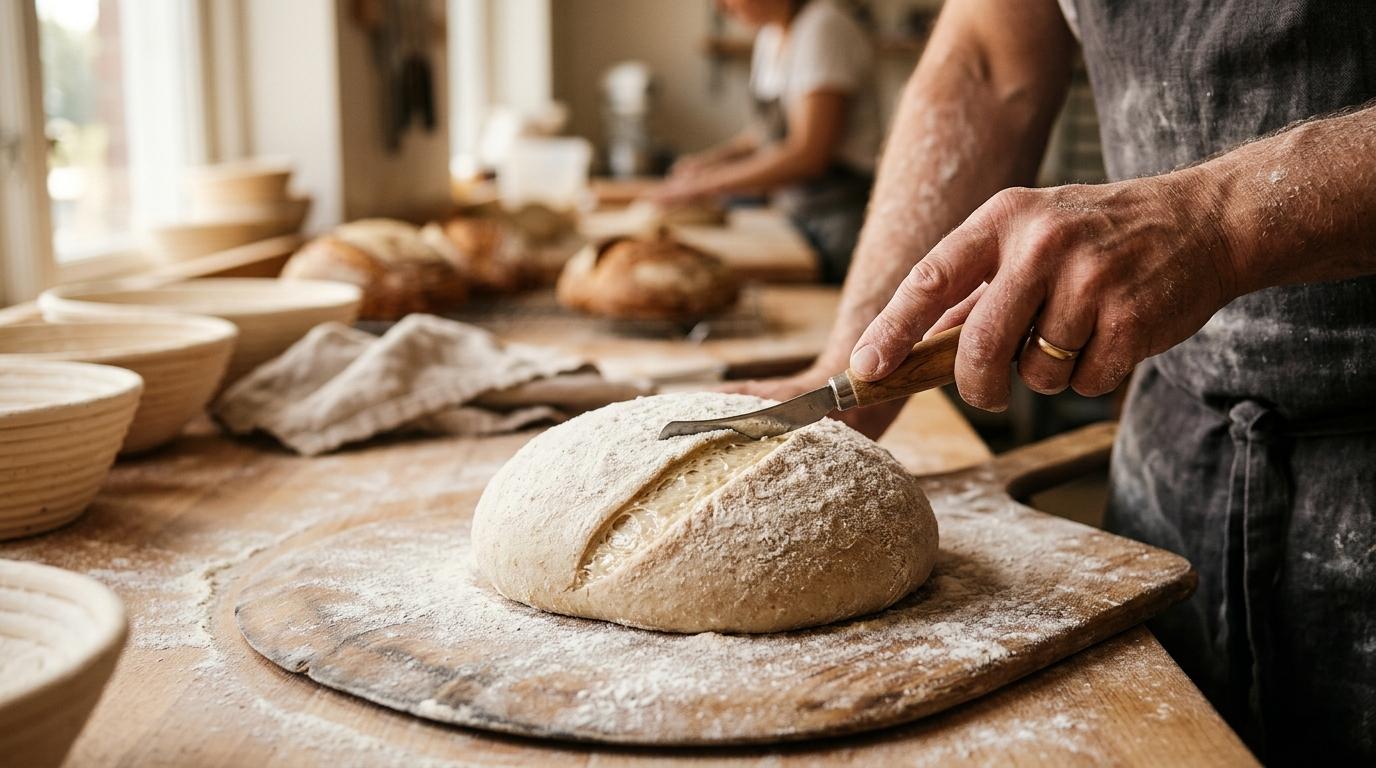
Why scoring matters
Bread dough releases gas as it bakes. Without a deliberate cut, the loaf finds its own weak point and tears unpredictably. Scoring gives you control over where and how it opens up.
A well-scored loaf bakes more evenly too. The slash creates an ear, that satisfying ridge of caramelised crust, and lets the oven spring do its best work in the first ten minutes of baking.
The ear and the bloom
The raised flap of crust along the cut is called the ear. The wider opening beside it is the bloom. Angle and depth together decide how pronounced each one is. Shallow cuts bloom wide; deep angled cuts build a taller ear.
Colder dough scores cleaner
Refrigerate your shaped loaf overnight and score it straight from the fridge. Cold dough holds its shape under the blade and gives you crisper edges.
Tools you need
A sharp blade is the only non-negotiable. A lame (a thin razor blade on a curved or straight handle) is the classic tool, but a serrated bread knife or a craft knife with a fresh blade both work well.
Lame vs. serrated knife
A lame glides through sticky dough without dragging. A serrated knife can snag if the dough is tacky, so dust lightly with flour first. Avoid thick chef's knives: they push the dough rather than cut it.
What to put the loaf on
Score on the banneton or lined bowl it proofed in, or transfer it to parchment on a peel first. Move fast: you want the loaf in the oven within two minutes of scoring so it doesn't lose tension.
Blunt blades deflate loaves
A dragging blade tears instead of cutting, and the friction can knock air out of a well-proofed loaf. Replace disposable razor blades after every few bakes.
Make the cut
Hold the lame at roughly 30–45 degrees to the surface of the loaf rather than straight down. A shallower angle creates a taller ear; more vertical gives a flat, wide-open bloom.
One confident stroke, not a series of small sawing motions. Start at the top and pull toward you in a single arc about 1–2 cm deep. Hesitation shows in the finished crust.
Common patterns
A single diagonal slash is the easiest starting point and suits most batards and bâtards. A central split works on tin loaves. For a boule, try a square pattern or a simple cross. Decorative leaf and wheat patterns come with practice but follow the same rules: confident, shallow, angled strokes.
Depth guide
For a standard sourdough, 1–2 cm is the sweet spot. Too shallow and the cut seals shut before the loaf opens. Too deep and you deflate the structure. With very wet, sticky dough, err slightly shallower.
Dust the top lightly with flour
A thin coat of rice flour on the surface before scoring helps the blade move cleanly and highlights the pattern once baked.
Troubleshoot and go further
If your ear doesn't form, the two most likely causes are a blade that wasn't angled enough or a loaf that overproofed and lost tension. Slack, overproofed dough won't hold open a cut, so the timing of your bake matters as much as the scoring itself.
If the cut seals closed, you scored too shallow or the oven wasn't hot enough at the start. A covered Dutch oven or a blast of steam in the first 15 minutes keeps the crust flexible long enough for the loaf to open fully.
Keeping a scoring journal
Photograph each loaf from the same angle before and after baking. Note the hydration, proof time, blade angle, and depth. Patterns emerge quickly and you'll dial in your signature cut within a dozen bakes.