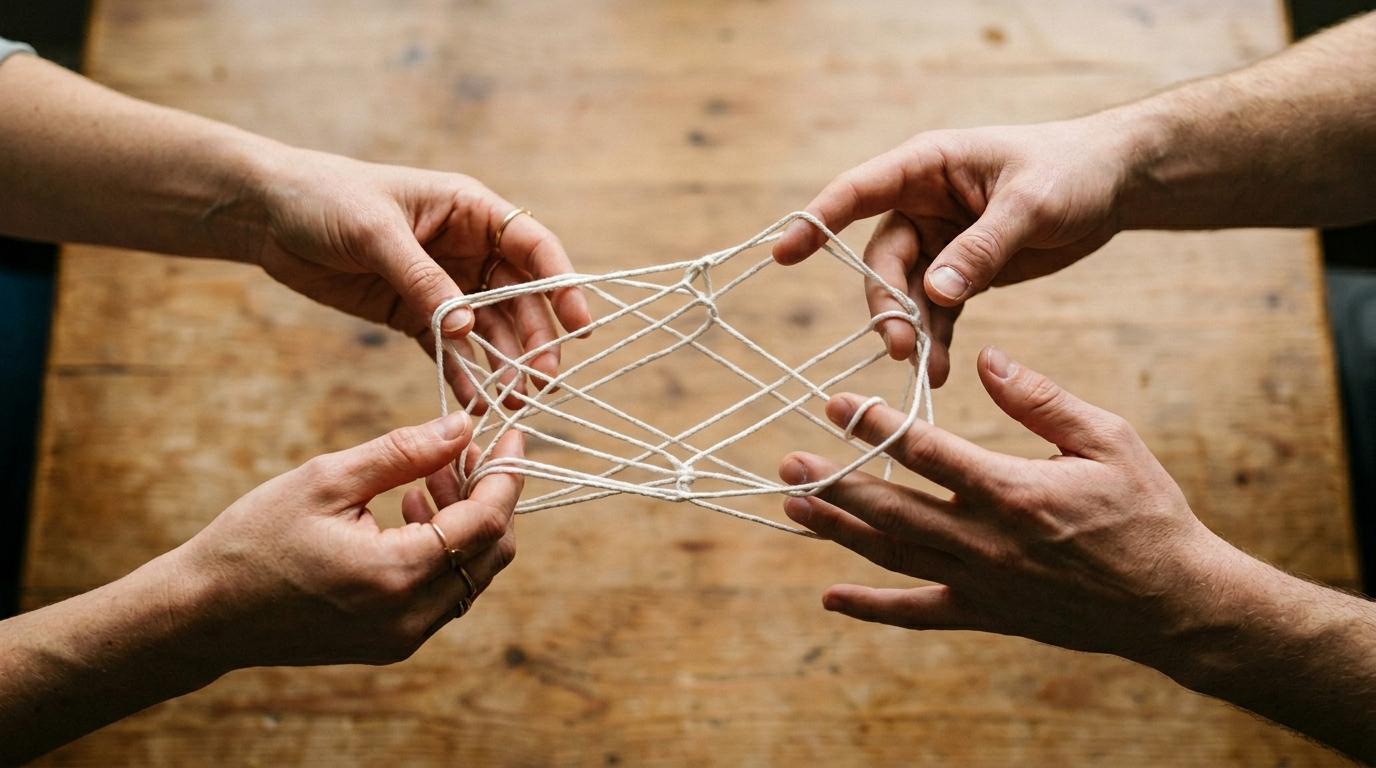
Get your string ready
All you need is about 150cm of soft string tied into a loop. Parachute cord, yarn, or even a shoelace works. Avoid stretchy elastic, which makes the figures collapse. Tie the ends with a simple overhand knot so the loop sits flat with no twist.
Sizing the loop
Hold the loop open between both thumbs. It should span roughly the width of your shoulders. Too short and your fingers jam; too long and the figures go slack. Adjust the knot until it feels right.
Best string to start with
Waxed linen cord or a dedicated cat's cradle string from a craft shop holds its shape best. Slippery nylon is the hardest material to learn on.
The Opening A position
Every figure starts from the same base called Opening A. Loop the string around both palms, then use your right middle finger to pull the left palm string toward you, and your left middle finger to pull the right palm string toward you. You now have two X-shapes across the string: that's Opening A.
Reading your hands
String figures use a simple vocabulary: near string means the strand closest to you, far string means the strand away from you. When instructions say "pick up the near thumb string with your index finger," slide the fingertip under that single strand from below and lift.
Common mistakes at this stage
If the X-shapes look uneven, your middle fingers have probably caught both strands instead of one. Drop everything, shake the loop out, and start the Opening A move slowly. Speed comes after the shape is right.
Muscle memory takes repetition
Most people nail Opening A cleanly after about ten attempts. Do it while watching TV. Your hands will sort it out faster than your brain will.
Cat's Cradle and the first figures
From Opening A you can build Cat's Cradle, the classic two-player exchange. Hold Opening A steady and have a partner pinch both X-crosses from above with their thumbs and index fingers, pull outward, dip down through the middle, and lift. The figure transfers to their hands in a new pattern called Soldier's Bed. Keep exchanging: each transfer makes a new shape.
Solo figures to practise first
Learning alone? Try The Fish or Jacob's Ladder. Both start from Opening A and need only your own two hands. Jacob's Ladder is a satisfying cascade of diamonds that most people can get in under fifteen minutes of focused practice.
How to read diagrams
Published string figure books use dot notation: a filled dot on a finger means the string passes over that finger, an empty dot means under. Once you crack that shorthand, any figure in any book becomes readable.
Film your own hands
Set your phone to record while you practise. Watching back at half speed shows exactly where a strand slips, far more useful than stopping and staring at tangled string in real time.
Going further
Once Cat's Cradle and Jacob's Ladder feel solid, the rabbit hole opens up. The International String Figure Association has catalogued thousands of figures from cultures worldwide, from simple shapes to multi-step constructions that take twenty minutes to complete. Many carry stories: Inuit hunters used them to pass down legends through winter nights.
Keeping figures in your memory
Group figures by their starting position (Opening A, Opening B, or the Navaho Opening) and you'll find patterns repeat across cultures. Learn the logic of moves, not just the steps, and you can improvise and recover when you lose your place mid-figure.
String figures as a social skill
Three or four figures is all you need. Useful at a table with kids, in a waiting room, anywhere a phone feels rude. A single loop of string in your pocket covers it.