The board has an address system
Every square on a chess board has a unique coordinate, like a grid on a map. Files are the eight columns, labelled a through h from left to right (from White's side). Ranks are the eight rows, numbered 1 through 8 from White's back row to Black's back row.
Reading a square
File letter first, then rank number. The bottom-left square from White's view is a1. The top-right is h8. White's king starts on e1, Black's king on e8.
Quick orientation trick
Sit on White's side. Your left edge is the a-file. Your closest row is rank 1. Every square follows from there.
Name the pieces, write the moves
Each piece has a one-letter abbreviation: K for King, Q for Queen, R for Rook, B for Bishop, N for Knight. Pawns get no letter at all: a bare square name means a pawn moved there.
Writing a basic move
Write the piece letter followed by the destination square. Knight jumps to f3: Nf3. Pawn advances to e4: e4. Captures add an x between piece and square: a bishop taking on g5 is Bxg5. A pawn capturing uses the file it started from: exd5 means a pawn on the e-file captured on d5.
Special moves
Castling kingside is O-O. Queenside is O-O-O. When a pawn reaches the back rank and promotes, add an equals sign and the new piece: e8=Q. Check is marked with a + at the end; checkmate with #.
Disambiguation
If two pieces of the same type can reach the same square, add the starting file or rank to clarify. Two rooks where both can go to d1: the one on a1 is Rad1, the one on f1 is Rfd1.
Read a full game score
Games are recorded as a numbered list of move pairs: White's move then Black's. Move 1 looks like 1. e4 e5: White played e4, Black replied e5. Each full pair is called a ply, and chess databases store millions of games in this format.
Following along in practice
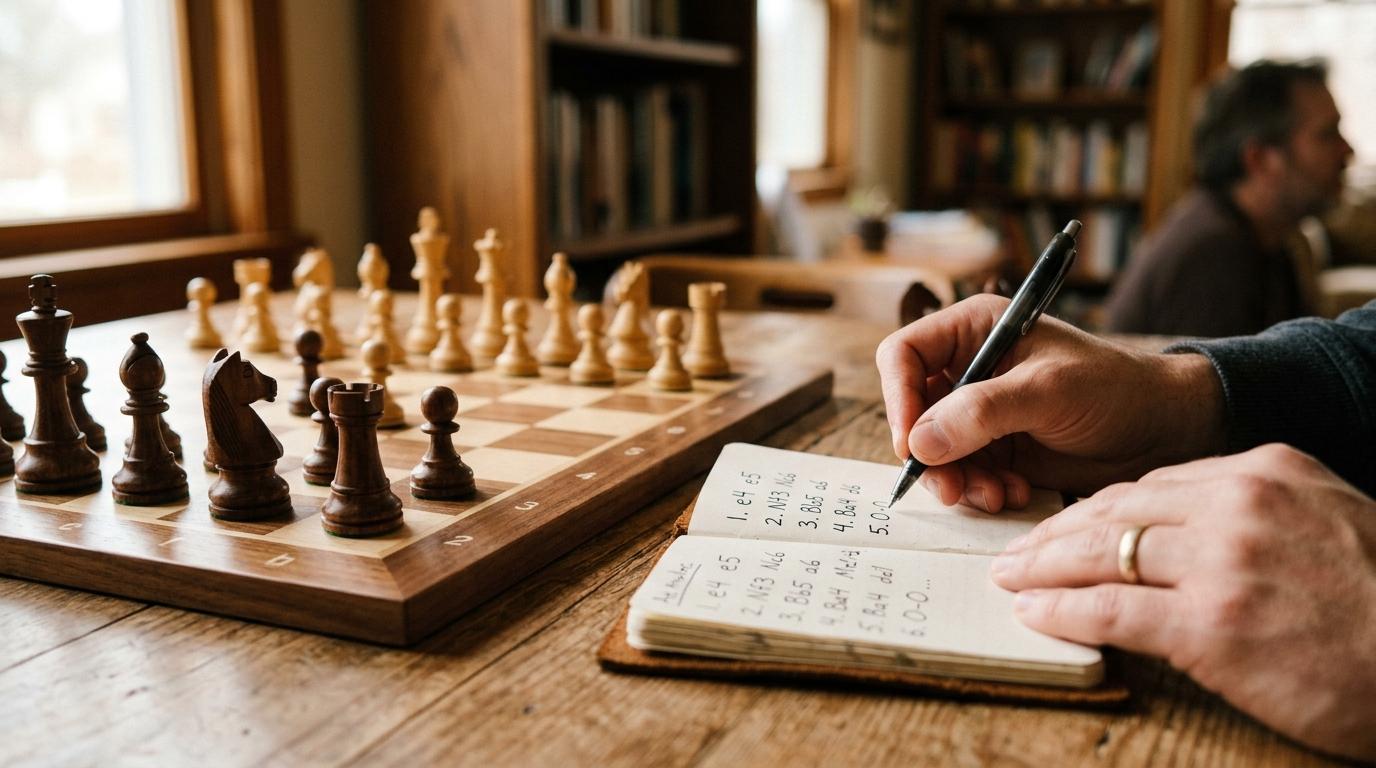
Take any famous game (the Immortal Game or a Fischer classic) and set up a board beside the score. Read one move, make it, read the next. After a few games your eye will scan notation as naturally as reading a sentence. You stop seeing symbols and start seeing positions.
Annotations you'll see
Published games often include evaluations inline. A ! means a good move, !! is brilliant, ? is a mistake, ?? is a blunder, !? is interesting, and ?! is dubious. These are the annotator's opinion, not part of the formal notation standard.
Use Lichess to check your reading
Paste any PGN game into Lichess's analysis board and step through it move by move. If the board matches what you pictured, your notation reading is solid.
Practice and go deeper
The fastest way to lock in notation is to record your own games as you play. Keep a scoresheet beside the board (or use an app) and write every move. After the game, replay it and find where things went wrong. Notation turns a game you'd forget in an hour into a lesson you can revisit forever.
Where to find games to read
Lichess and Chess.com both let you download games as PGN files, the standard plain-text format that stores moves in algebraic notation. Opening a PGN in any chess app gives you an interactive board. Start short: a Scholar's Mate in four moves or an Italian Game opening line is enough to get comfortable before tackling a 60-move endgame.