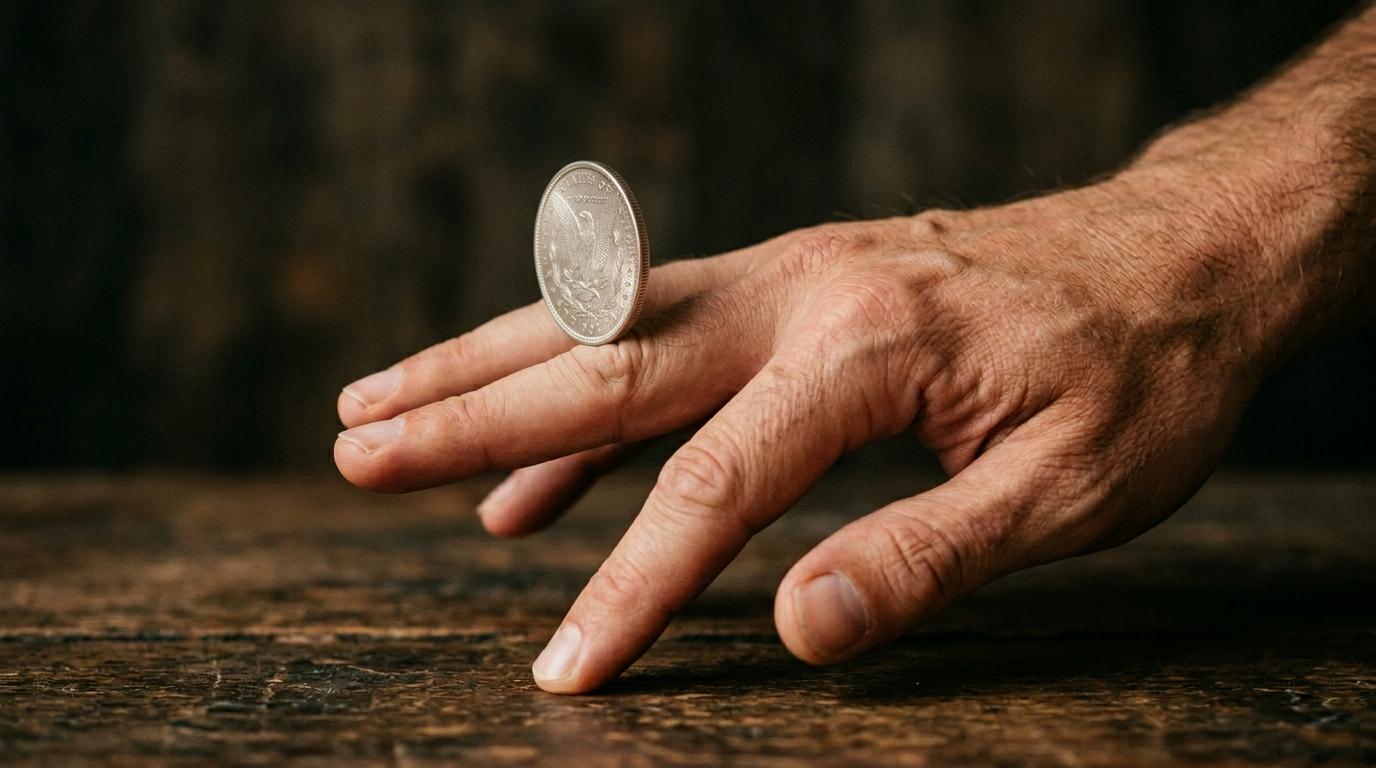
Grab the right coin
Not all coins work equally well. You want something with a bit of weight and a clean edge: a quarter or a 50p is ideal. Thin, light coins like dimes slip off before you can catch them.
Starting position
Hold your hand out flat, palm down, fingers together. Place the coin on its edge on the back of your index finger, resting against your thumb. That pinch between thumb and index finger is your launch point for every repetition.
Use a practice surface
Do this over a bed or cushion while you're learning. You'll drop the coin constantly at first, and chasing it across a hard floor gets old fast.
The rolling motion
The coin travels across your knuckles by a series of small tilts, not one fluid sweep. Each finger lifts just slightly to let the coin tip over it, then catches the coin on the next knuckle. Think of it as passing, not sliding.
Finger by finger breakdown
Start with the coin between thumb and index finger. Tilt your index finger down so the coin falls onto the gap between index and middle knuckles. Your middle finger rises to catch it. Repeat for middle to ring, then ring to pinky.
The pinky reset
When the coin reaches your pinky, it has nowhere left to go. Tuck your pinky down so the coin slides off into your palm, then use your thumb to clip it back to the starting position between thumb and index. This is the part that looks like magic to onlookers: the reset is invisible when done smoothly.
One finger at a time
Isolate each transition before stringing them together. Spend five minutes just doing index to middle before moving on. Rushing creates sloppy habits that are hard to unlearn.
Building smoothness
At first your movements will look mechanical and jerky. That's fine. The goal for the first few sessions is consistency, not speed. Every drop is your brain gathering data.
Practice in short bursts
Five focused minutes beats thirty distracted ones every time. Do a set while waiting for the kettle, watching TV, or on the bus. The trick benefits from idle repetition rather than dedicated drill sessions because your hands relax and stop overthinking the motion.
The wall test
Once you can cross all four knuckles without dropping, try it without looking at your hand. If you can hold a conversation while the coin rolls, you've learned it. That's the benchmark separating someone who practised from someone who knows the trick.
Slightly bent fingers help
Many learners hold their hand too flat and stiff. Relax your fingers into a soft curve. The coin sits more securely in the natural groove between knuckles when your hand is relaxed rather than rigid.
Where to go from here
The coin roll is a gateway into coin magic and flourishing. Once the basic roll feels automatic, you're ready for the back-palm, the Erdnase change, or coin vanishes that use the same pinky-to-palm mechanics you just learned.
Linking it to other skills
Coin flourishing sits within a wider world of contact juggling and sleight of hand that rewards the same patient, repetitive solo practice. Pen spinning uses nearly identical finger-isolation principles. Card flourishes share the same relaxed-hand philosophy. Each skill you pick up makes the next one faster to learn.
Your dominant hand first
Get it clean on your dominant hand before attempting the other. Some people never bother with the off-hand version. That's fine. One smooth hand is more impressive than two shaky ones.