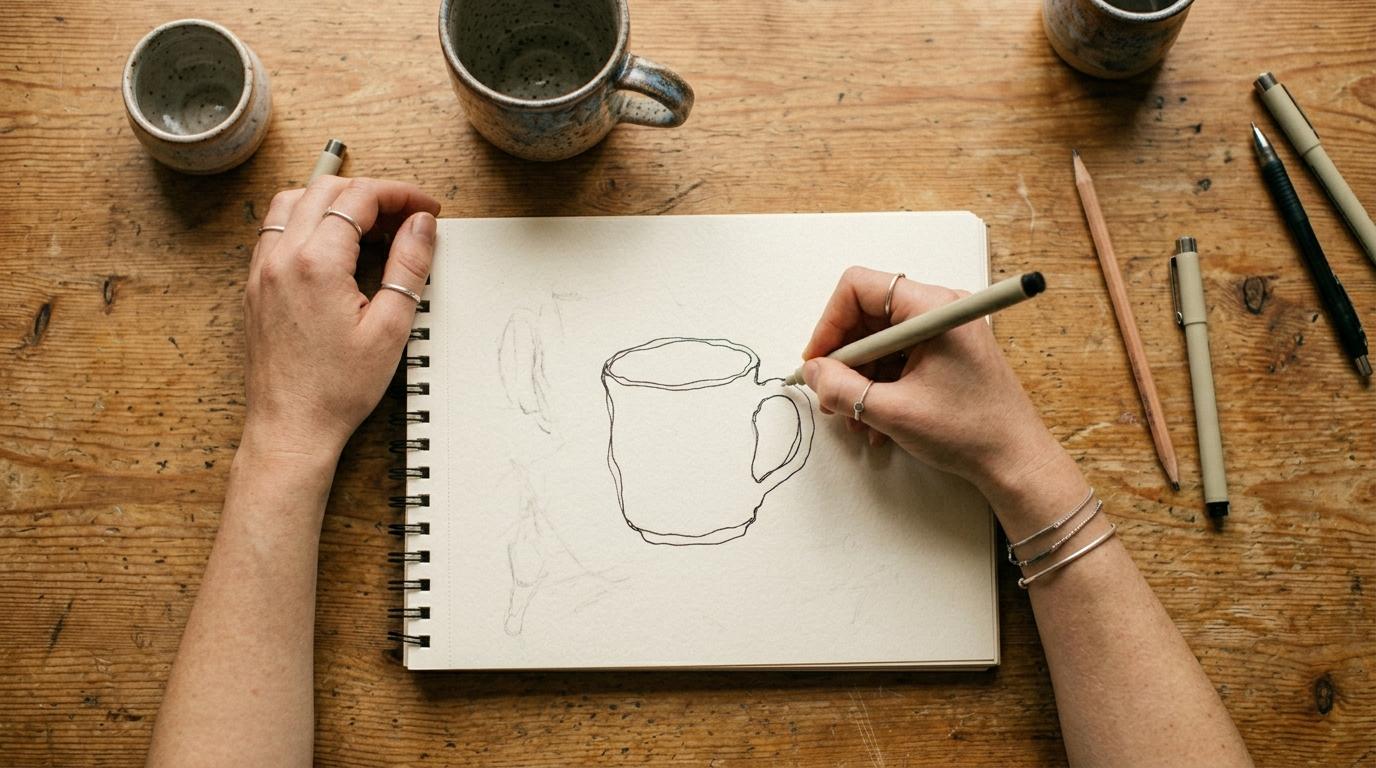
What blind contour drawing is
Blind contour drawing means tracing the edges of your subject with your eyes while your pen moves across the paper, without ever peeking at what you're drawing. The result looks wonderfully weird. That's the point.
The technique was developed by art teacher Kimon Nicolaïdes in the 1940s as a way to break the habit of drawing symbols instead of what you actually see. Your brain stores a shorthand for "eye" or "hand". Blind contour forces you to ignore it and observe reality.
Why it works
Most beginners draw what they think things look like, not what they actually look like. Blind contour severs that shortcut. You slow down, you really look, and your hand-eye coordination sharpens with every session.
Set realistic expectations
Your first blind contour will look like a toddler's fever dream. Every artist's does. That's not failure. That's exactly what's supposed to happen.
What you need and how to set up
You need almost nothing: a pen or pencil, a piece of paper, and something to draw. Pen is better than pencil for beginners because you can't erase: it keeps you committed to each line.
Choosing your subject
Start with your own non-dominant hand. It's always available, full of interesting wrinkles and knuckles, and holds still as long as you pose it. Prop it up naturally in front of you: relaxed, slightly curled, or resting on the table.
The setup rule
Once you start drawing, your eyes must stay on your hand. Some people tape a piece of card over their drawing hand to physically block the view. You can also just commit to the honour system, but no peeking, even when it feels uncomfortable.
Time yourself
Set a timer for 5 minutes per drawing. Moving too fast defeats the purpose. You want to feel like you're moving your pen at the same slow pace your eye is travelling along the contour.
The drawing process, step by step
Place your pen on the paper. Fix your eyes on an edge of your subject: a fingernail, a knuckle, the outer curve of your thumb. Begin moving your eye slowly along that edge, and let your hand mirror exactly what your eye is doing.
Moving through the drawing
Imagine your pen tip is a tiny ant crawling along the actual surface of your hand. When your eye travels into a valley between fingers, your pen dips. When it climbs over a knuckle, your pen rises. Never lift your pen during a single contour: keep it in contact with the paper the whole time.
What to do when you finish
When the timer goes off, look at your drawing. It'll be distorted, scrambled, possibly unrecognisable. Hold it up anyway. You'll almost certainly see something unexpectedly expressive in it. Notice where the lines have confidence and where they hesitate. That tells you where your observation was strongest.
Do at least three in a row
The first drawing is always stiff. By the third, your eyes and hand start to sync. Keep a small sketchbook just for blind contours and fill a page a week: progress is visible within a month.
Going further and useful resources
Once hands feel comfortable, try faces, shoes, plants, or objects on your desk. You can also do modified contour drawing: the same slow observation, but with occasional quick glances at your paper to reorient. This bridges blind contour toward real observational drawing.
Building a practice
Five minutes of blind contour before any drawing session works like a warm-up stretch for your eye. Many illustrators and painters swear by it as a daily ritual to stay sharp. You don't need to produce gallery-worthy work. You just need to look, really look, at the world in front of you.