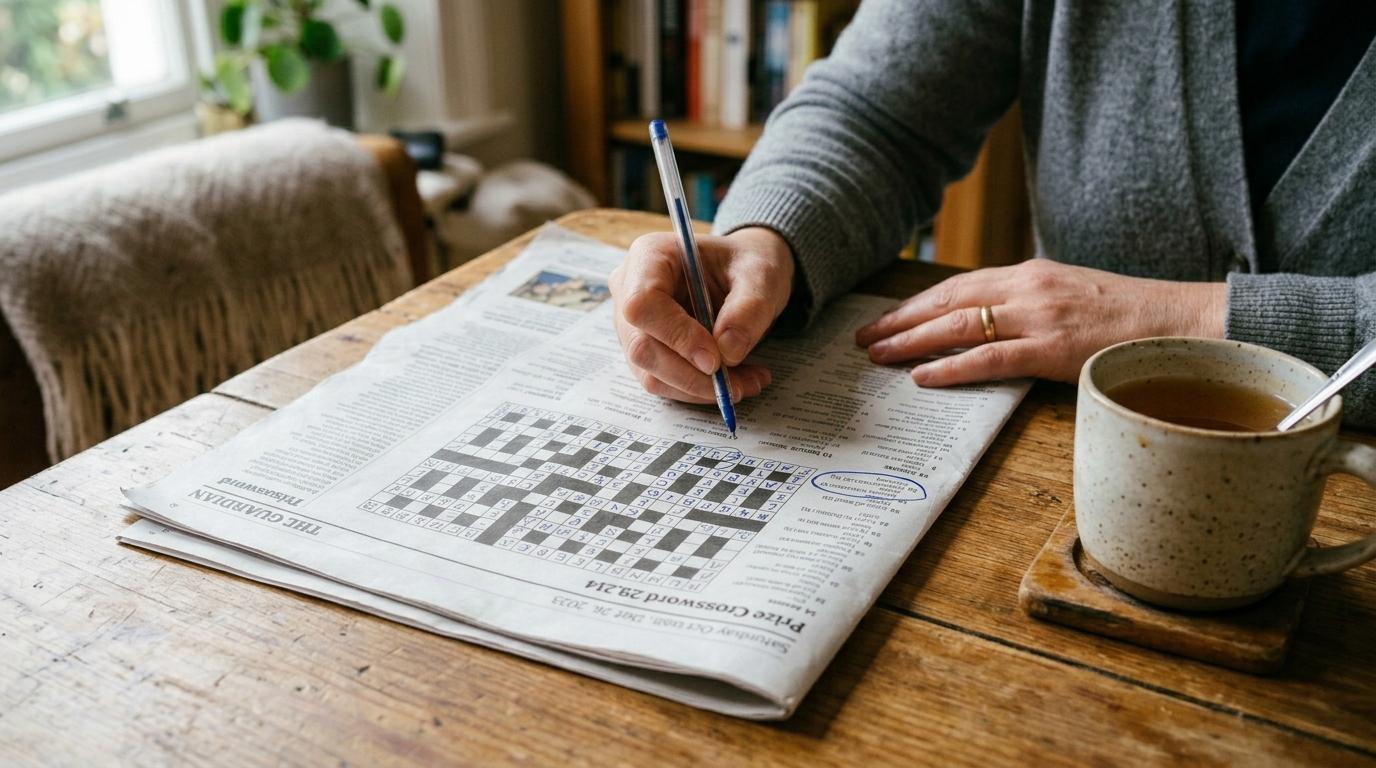
How cryptic clues work
Every cryptic clue has two parts: a straight definition (like a normal crossword) and a wordplay section that arrives at the same answer by a different route. The definition is always at the start or end of the clue, never in the middle. Your job is to identify which part is the definition and which is wordplay, solve both, and confirm they match.
An example
"Composer found in the Alps, bizarrely (5)"
Found in is the definition: a composer. The Alps, bizarrely is wordplay: an anagram indicator (bizarrely) tells you to rearrange the letters of THE ALPS. Rearranging T-H-E-A-L-P-S gives PSALTHE... no. Try ELPATH... PHETAL... ELSPATH... try just ALPS: A-L-P-S rearranged = SLAP, LAPS, ALPS, PALS... five letters from THE ALPS: LISZT? No. ELGAR? No. Rearrange ALPS, THE → SALTHE ... let's try THALES... The answer is LISZT. And LISZT can be found in the ALPS, bizarrely isn't quite right. This illustrates that solving cryptics takes practice, and that's the point.
The definition is always at the start or end
This is the single most useful rule. Once you've identified the definition, you can ignore the wordplay and use crossing letters to guess the answer, then verify it with the wordplay.
The eight clue types
1. Anagram
Letters are rearranged. Indicator words: bizarrely, mixed up, confused, broken, new, wildly, oddly. Example: "Confused artist (4)" → rearrange ARTIST → no, only 4 letters needed → rearrange RATS → STAR, TSAR, ARTS.
2. Hidden word
The answer hides inside the clue. Indicator words: in, inside, within, contains, some of, part of. Example: "Some paRTLY hidden (4)" → hidden inside = RTLY... → RTLY → look at: paRTLy → no → "Some flowers in the GARDEN (4)" → gARDEn → ARDE... → "Seen in the CASTLE (6)" → theCAS TLE → CASTLE itself? No. Try: "Edward found in BEd WARd (6)" → bEDWARd → EDWARD.
3. Double definition
Two separate definitions for the same word. Example: "Tree trunk (5)" → TRUNK = a tree trunk, TRUNK = a suitcase, TRUNK = an elephant's trunk. The answer is TRUNK.
4. Reversal
A word read backwards. Indicator words: back, returning, going up (in down clues), over. Example: "Back in fashion (3)" → reverse NOW = WON? Reverse MOD = DOM? Example: "Transport returning (3)" → BUS backwards = SUB.
5. Charade
Two or more words joined. Example: "Soldier insect (3)" → ANT (soldier) + ... OR ANT (insect) = ANT. "Nice and quiet (5)" → GOOD + NIGHT... OR SOFT + LY... Example: "Male sheep direction (6)" → RAM + PAGE... Or: R (right) + AM + PAGE = RAMPAGE.
6. Container
One word placed inside another. Indicator words: in, within, contains, holds, around, outside. Example: "Fish in the garden (5)" → EEL inside GARDEN → gARDEn → EEL inside something → GREED? → put EEL in P... Hmm.
7. Homophone
The answer sounds like another word. Indicator words: heard, sounds like, reportedly, they say, aloud. Example: "Reportedly the price is right (4)" → sounds like FAIR = FARE.
8. &lit / all-in-one
The entire clue is both the definition and the wordplay. Rare and much admired by setters. Example: "O, it's in our direction! (5)" → anagram of O IT'S = TOIS... TOILS... TOILS? No. Anagram of NORTH? Worth pursuing later.
How to approach a clue
- Count the letters. The number in brackets tells you how many. (4,3) means two words.
- Identify the definition: the straight part at the start or end.
- Identify the wordplay type: look for indicator words.
- Solve both sides independently and look for a word that satisfies both.
- Use crossing letters from answers you've already got to narrow the options.
Start with short answers
Three- and four-letter answers have fewer possibilities. Get those first, then use crossing letters to crack the longer ones.
Where to practice
The Guardian Quick Cryptic is the best starting point: designed for beginners, published daily online for free. The Times Cryptic is the gold standard of difficulty. The i newspaper cryptic sits comfortably between the two.