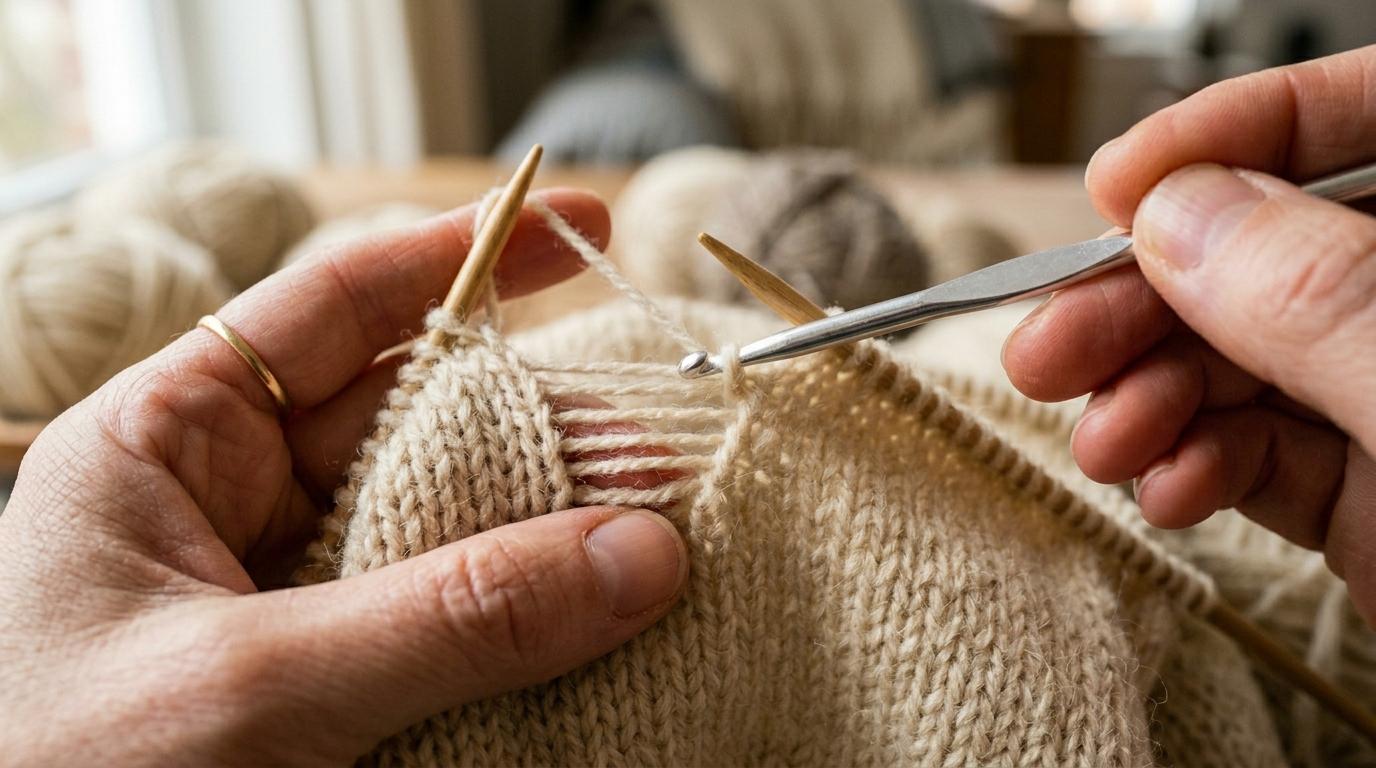
Spot the problem before it gets worse
A dropped stitch is a live loop that's slipped off your needle and started sliding down the fabric, leaving a vertical ladder of loose horizontal strands behind it. The moment you notice it, stop knitting: every row you work pulls it further down.
What you're looking at
The dropped loop sits at the bottom of the ladder. Count the rungs above it: each one is a row you'll need to recapture. One or two rungs is a quick fix; ten rungs takes a few extra minutes but the method's identical.
Use good light
Hold your work up to a lamp or window. Ladders are easy to miss in dark yarn or busy stitch patterns until they've already travelled several rows.
Grab a crochet hook and pick it up
You need a crochet hook roughly the same size as your knitting needles. Insert the hook through the dropped loop from front to back. That's the detail that keeps your stitch orientated correctly as a knit stitch.
The pickup motion
With the hook pointing away from you and the loop on the hook, reach forward and catch the lowest rung of the ladder, the horizontal strand directly above the loop. Pull that strand through the loop toward you. You've just re-knitted one row. Repeat for every rung, working upward until you reach the current row.
Purl stitches need a small twist
If the dropped stitch sits in a purl column, insert the hook from back to front instead, then catch the rung and pull it through. The logic's the same; the direction's reversed because purls face away from you.
No crochet hook handy?
A spare needle tip or even a pencil can trap the loop in a pinch, but a crochet hook grips the rung cleanly and makes the repair far less fiddly.
Return the stitch to your needle correctly
Once you've climbed back to the current row, the rescued loop should sit on your crochet hook. Slide it onto the left needle so the right leg of the loop sits in front. That's the correct resting position for a knit stitch. If the stitch looks twisted when you knit it, it mounted the needle the wrong way; slip it off and flip it before continuing.
Check your tension
Gently tug the fabric around the repair. If the rescued column looks noticeably tighter or looser than its neighbours, ease yarn in from the surrounding stitches with your fingers. Small adjustments spread across several stitches blend in and become undetectable once the piece is blocked.
Block it out
Wet blocking after finishing will relax any tension irregularities around the repair until they're gone completely.
Prevent it happening again
Most dropped stitches happen when you put your work down mid-row and the needle tip slips out, or when you accidentally knit into the yarn rather than the stitch. A few habits make it rare: always stop at the end of a row, use needle stoppers on the tips when you set the project down, and count your stitches every ten rows or so.
Practice on a swatch
Cast on 20 stitches and deliberately drop one. Rescue it. Drop it from further down. The more you practice on a test swatch with no stakes, the calmer you'll be when it happens mid-project on something you care about.
Slippery yarn drops fast
Silk, bamboo, and superwash wool have almost no grip. If you're working with a slippery fibre, check your stitches more often and consider wooden or bamboo needles, which hold yarn better than metal.