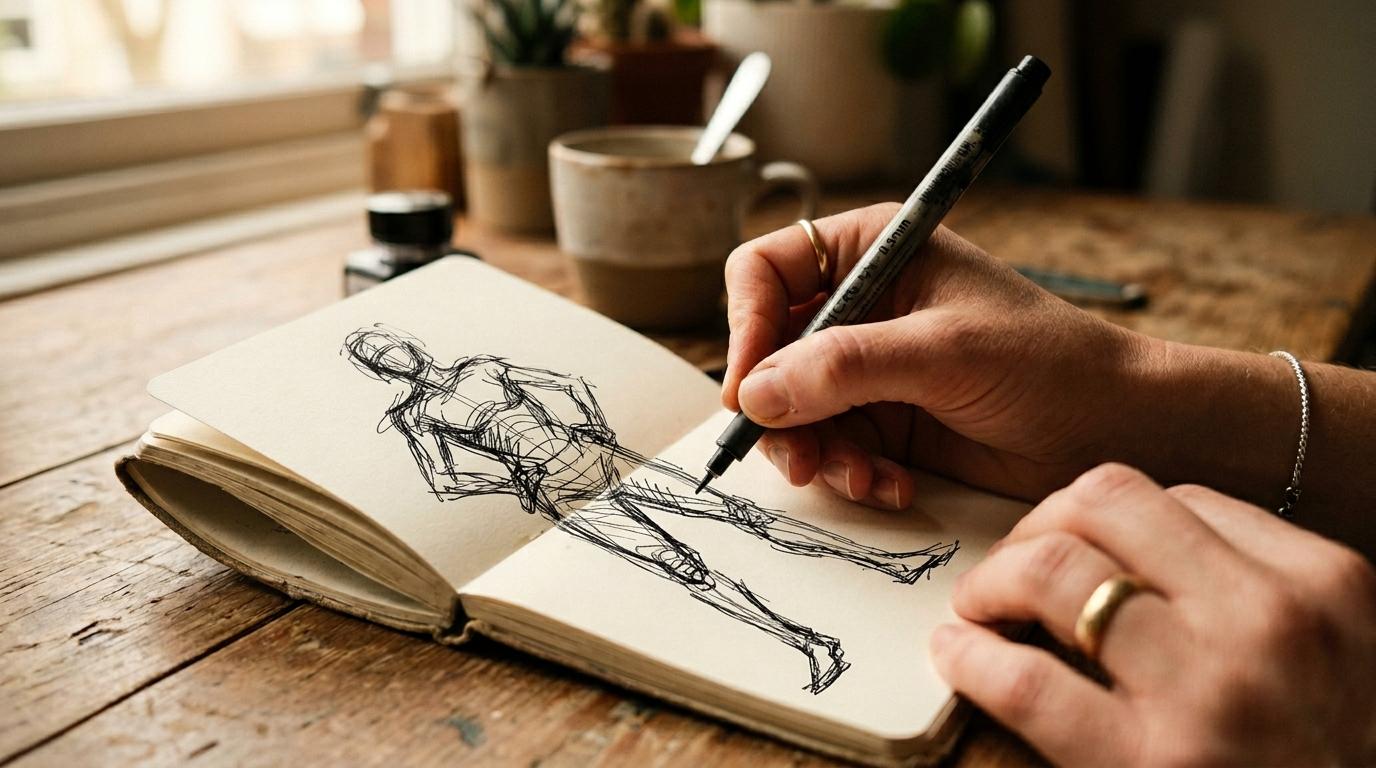
What gesture drawing is
A gesture drawing captures the energy and movement of a pose, not the details. You're drawing how the body feels, not how it looks. A 60-second gesture is almost all line: no shading, no erasing, no refining. The time limit forces you to find what's essential.
Why it works
Most drawing problems come from copying outline instead of understanding structure. Gesture drawing rewires your eye to look for the line of action, the main curve running through the spine, and to feel weight distribution before you draw a single contour.
The C, S, and I shapes
Most human poses reduce to one of three spine curves: a C (leaning to one side), an S (contrapposto, the classical shifted-weight pose), or an I (upright, stiff). Before your pencil touches paper, identify which shape the pose is. Draw that first.
The five-line figure
You can draw a convincing human figure with five lines: the spine, two arms, and two legs. Nothing else. This is your starting framework for every gesture drawing.
- Spine first: draw the curve of the spine from head to tailbone. Get the lean right.
- Shoulder line: a single line across both shoulders. Note whether they tilt.
- Hip line: same thing, across both hips. Shoulders and hips usually tilt opposite ways in a relaxed pose.
- Legs: two curved lines from the hip line down. Get the weight-bearing leg right first.
- Arms: two lines from the shoulders. Let them hang naturally unless they're doing something specific.
Only after these five lines are down do you consider any further marks. At 60 seconds, five lines is often all you have time for, which is fine.
Practice right now
Go to line-of-action.com, a free tool that shows you timed figure poses. Set it to 60 seconds and draw 10 poses in a row. Then try 30 seconds. Then 2 minutes. Different time limits train different things: short times force you to find the essential line; longer times let you build on it.
Materials
Any paper and any pencil. A mechanical pencil at medium pressure works well. Don't use an eraser during gesture drawing: the constraint is the point. If a mark is wrong, draw over it. The wrong marks often show you how your eye is improving.
Do ten gestures before you stop
One gesture drawing teaches you almost nothing. Ten in a row teaches you a great deal. Don't stop after one or two when they feel bad: the bad ones are where the learning is.
Going further
Once 60-second gestures feel comfortable, try 5-minute poses: time enough to lay gesture over the top and then begin to build structure. The jump from gesture to construction is where figure drawing opens up.