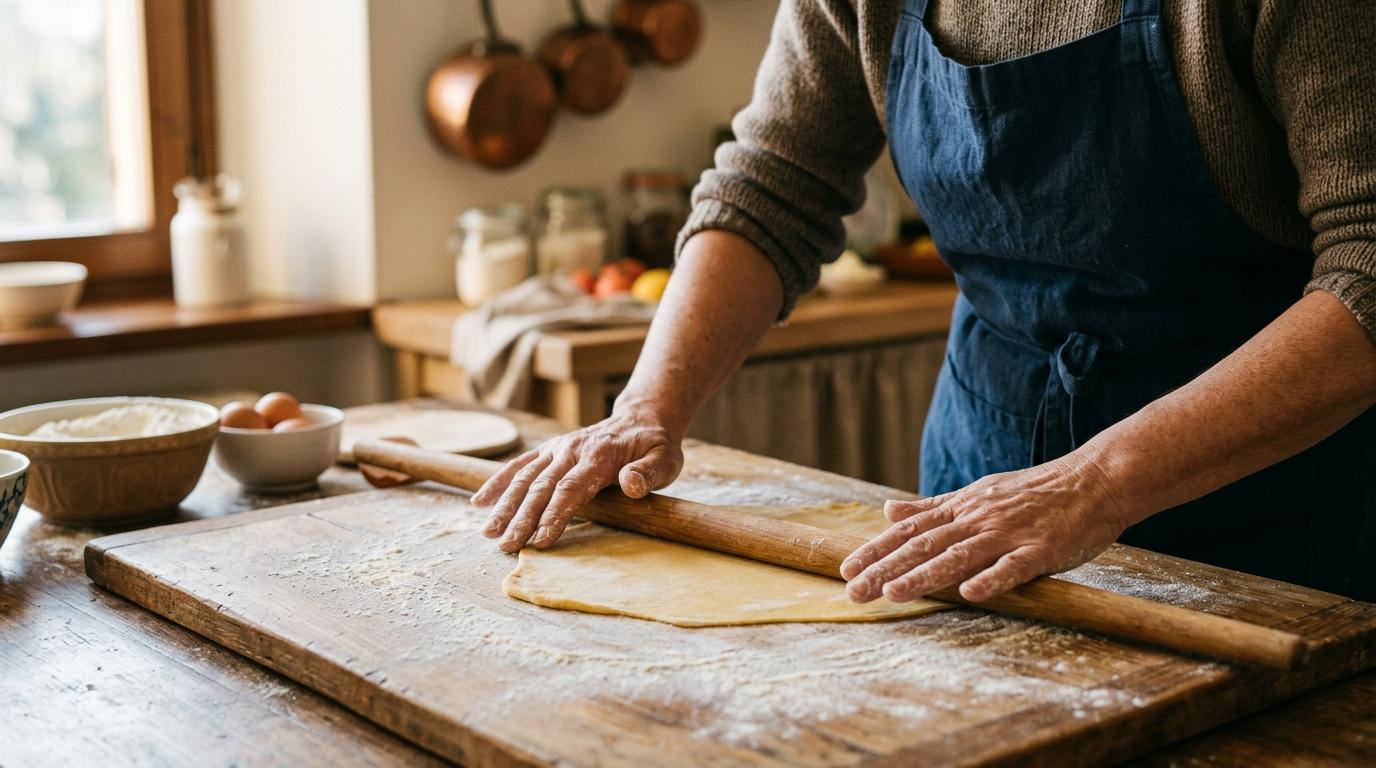
Mix and knead your dough
Hand-rolled pasta starts with a simple dough: 00 flour (or plain all-purpose) and eggs. The ratio that works every time is 100g of flour per egg. Pile your flour on a clean surface, make a well in the centre, crack your eggs in, and fork them into the flour from the inside out.
Kneading is the real work
Once the dough comes together, knead it firmly for 8 to 10 minutes: push with the heel of your hand, fold, rotate, repeat. You're developing gluten, which is what gives pasta its satisfying bite. The dough should become smooth, slightly tacky, and spring back when you poke it.
Sticky or crumbly?
If the dough sticks to your hands, dust with a tiny bit of flour. If it crumbles, wet your hands slightly and keep kneading. It'll come together.
Rest the dough
Wrap the dough tightly in cling film and let it rest at room temperature for at least 30 minutes. This isn't optional. Resting relaxes the gluten so the dough rolls out smoothly instead of snapping back at you like a rubber band.
What happens during the rest
The flour fully hydrates and the gluten network loosens. Dough you try to roll immediately will tear and fight you. After 30 minutes it turns cooperative, pliable, and a pleasure to work with. You can rest it up to 4 hours in the fridge if you want to prep ahead.
Resting overnight
Refrigerating overnight deepens the flavour slightly. Bring it back to room temperature for 20 minutes before rolling, or it'll be stiff.
Roll it thin with a rolling pin
Dust your surface and rolling pin well with flour. Flatten the dough into a rough disc, then roll from the centre outward, rotating the sheet a quarter turn after every few passes. Your target thickness depends on the shape: 2mm for tagliatelle, closer to 1mm for delicate shapes like pappardelle.
The wrap-and-roll trick
When the sheet gets large and hard to manage, drape the far edge over your rolling pin and roll it toward you, pressing gently as you go. This stretches the dough evenly and gets you much thinner than hand-pushing alone. Unroll, rotate, repeat until you can see your hand faintly through the sheet.
Cutting tagliatelle
Flour the sheet generously, then fold it loosely into a flat roll, like a loose scroll. Cut across the roll at your desired width, 5–8mm for tagliatelle. Shake the ribbons out immediately so they don't stick together, and dust with more flour. Cook within 30 minutes or hang to dry for later.
Even thickness matters
Uneven pasta cooks unevenly. Spend extra time on thick patches rather than rushing to get it large. A smaller even sheet beats a wide patchy one.
Cook and go further
Fresh pasta cooks fast: 2 to 4 minutes in well-salted boiling water. Taste it early. It should have a gentle chew, not feel doughy. Reserve a cup of pasta water before draining: the starchy water helps loosen sauces and makes them cling to the noodles.
Simple sauces that let the pasta shine
Brown butter with sage, a quick tomato sauce, or just good olive oil and Parmesan: fresh pasta is rich enough that simple sauces work best. Heavy meat ragus are great too, but let your first batch be something light so you can actually taste what you made.
Freeze extra portions
Nest fresh pasta into loose nests, freeze on a tray until solid, then bag them. Cook straight from frozen and add 1 extra minute to the cook time.