What the island strum is
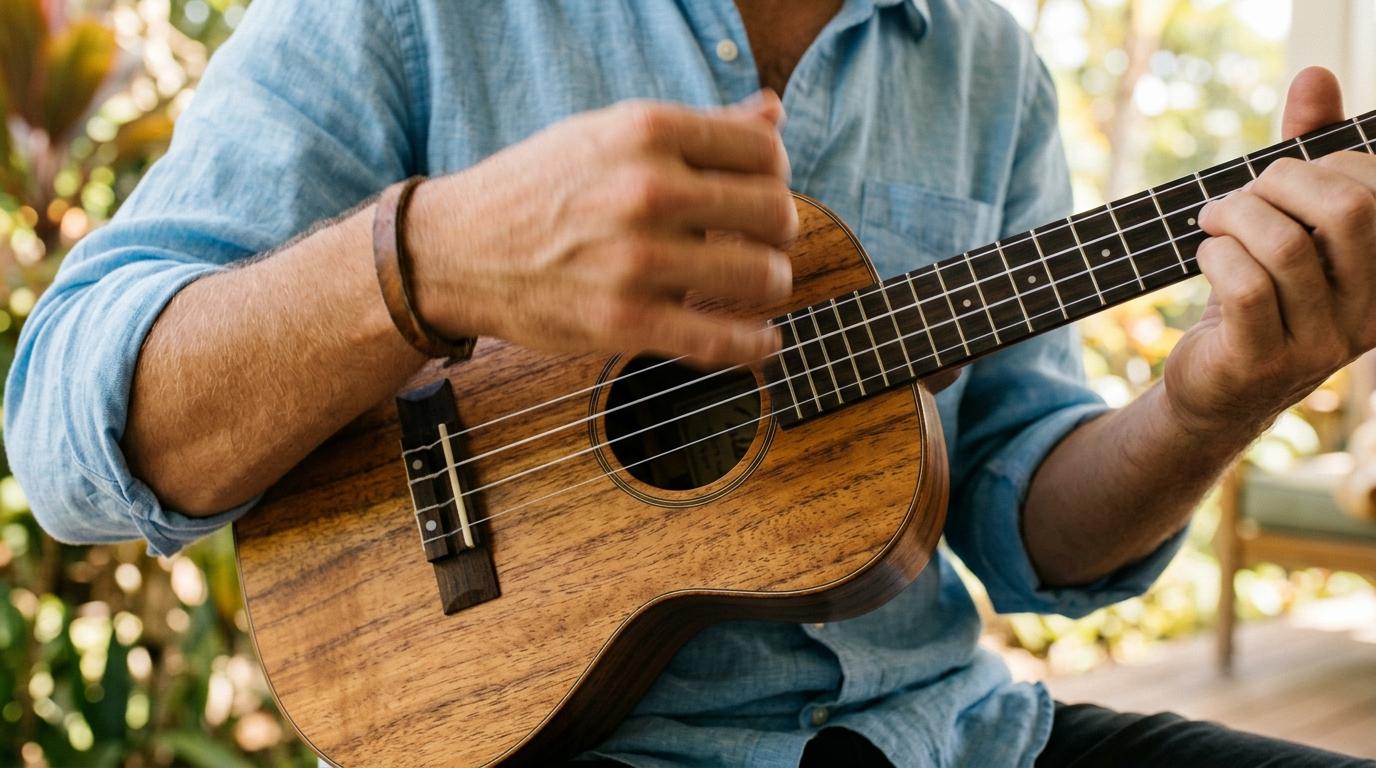
The island strum is the signature ukulele rhythm you hear in pretty much every beachy, carefree uke song. It goes down, down-up, up-down-up: seven strokes per bar, fitting neatly into 4/4 time.
Written out as a rhythm pattern it looks like this: D DU UDU. The trick is that the first U (upstroke) in the middle is a ghost stroke: your hand moves up but doesn't hit the strings. That silence is what gives the pattern its bouncy, syncopated feel.
Why this pattern specifically
Most beginners learn a plain down-down-down-down strum and wonder why their playing sounds flat. The island strum adds movement between beats. That's what makes ukulele feel lively rather than mechanical.
Use your index finger first
Start with just your index fingernail strumming down and the pad of your finger brushing up. Once it feels natural you can experiment with a full hand strum or a thumb strum.
Breaking it down stroke by stroke
Start without any chord. Rest your fretting hand lightly on the strings to mute them, so you can focus entirely on your strumming hand.
The seven strokes
Beat 1: D, a clean downstroke. Beat 1-and: D, another downstroke, quick. Beat 2: U, upstroke (this is the ghost: hand moves up but strings are silent). Beat 2-and: U, upstroke, this one hits the strings. Beat 3: D, downstroke. Beat 3-and: U, upstroke. Beat 4: U, upstroke to close out.
Practise in slow motion
Set a metronome to 60 BPM or slower. Say the pattern out loud: "down, down-up, up-down-up" while your hand moves. Matching your voice to your hand is one of the fastest ways to lock in rhythm patterns.
The ghost stroke is the hard part
Most people either skip it entirely or accidentally hit the strings. If you're hitting strings on the ghost upstroke, relax your wrist. Your hand should swing loosely, not reach for the strings.
Putting it over a real chord
Once the strumming hand feels automatic at slow tempo, fret a C chord: ring finger on the third fret of the A string, everything else open. That single chord is enough to practise the full pattern.
Bump the metronome up in small steps: 60, 70, 80, 90 BPM. At each speed, aim for ten clean repetitions before moving up. Clean and slow beats fast and sloppy every time.
A simple two-chord song to try
Swap between C and F (first fret on E string, second fret on G string) on the island strum. That two-chord loop is the skeleton of countless songs: Somewhere Over the Rainbow, Riptide, and I'm Yours all orbit around simple chord pairs with this exact strum feel.
Chord changes feel slow at first
When you need to switch chords, look at the chord you're moving to before your hand gets there. Anticipating the shape even half a beat early makes transitions feel smooth instead of panicked.
Where to go from here
The island strum is your foundation. From here you can add muting (press your strumming hand against the strings on beat 3 for a percussive chick sound), vary the pattern by dropping strokes, or try a chunking variation where you slap the strings instead of strumming them.
The best next step is learning three or four open chords (C, F, G, Am) so you can play full songs rather than loop exercises. Once the muscle memory for island strum is solid, your fretting hand can take centre stage.
Keep sessions short
Fifteen minutes a day beats two hours on the weekend. Your fingers need time between sessions to consolidate the movement patterns, and your fingertips need time to toughen up.
Record yourself once a week
Even a voice memo on your phone. Listening back is the fastest way to hear whether your timing is steady or just feels steady in the moment.