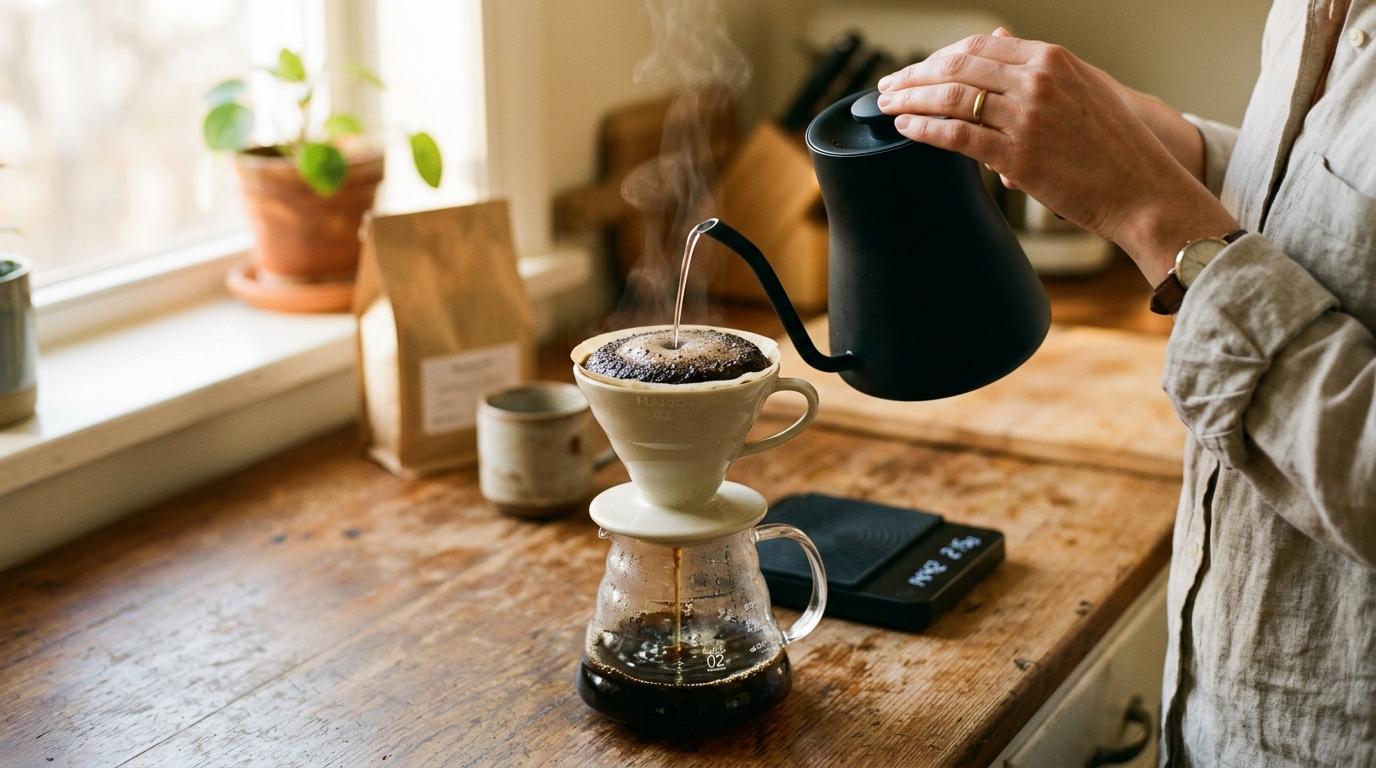
Gather your gear
Pour-over coffee rewards you with a cleaner, brighter cup than a drip machine, but it asks for a little attention in return. You only need a few things to start, and most are one-time purchases that last years.
What you need
At minimum: a pour-over dripper (Hario V60 or Chemex are the classics), paper filters sized to match, a kettle, fresh coffee beans, and a mug or carafe underneath. A kitchen scale and a gooseneck kettle will make life easier, but neither is required on day one.
Beans matter most
Buy whole beans and grind them just before brewing if you can. Pre-ground coffee goes stale fast and is the single biggest reason home coffee disappoints.
Dial in your ratio and grind
A reliable starting ratio is 1 gram of coffee per 15–16 grams of water. For a standard 300ml cup, that's around 20g of coffee. No scale? Two heaped tablespoons per cup is a reasonable starting point.
Getting the grind right
For a V60 or similar dripper, aim for a medium-fine grind, roughly the texture of coarse sand. Too fine and the water drains slowly, making the coffee bitter. Too coarse and it drains in under two minutes, tasting weak and sour. If your grind is off, that's the first thing to adjust.
Water temperature
Ideal brew temperature is 90–96°C. No thermometer? Boil the kettle and let it sit for 30–45 seconds before pouring. Scalding water pulls harsh flavours; water that's too cool extracts too little.
The bloom is not optional
Always do the bloom. It matters. Stale gases in fresh coffee repel water and cause uneven extraction if skipped.
Brew it step by step
Place your filter in the dripper and rinse it thoroughly with hot water. This removes papery taste and pre-heats everything. Discard that water, then add your ground coffee and give the dripper a gentle shake to level the bed.
The bloom pour
Start a timer. Pour just enough water to saturate all the grounds: roughly twice the weight of your coffee (so 40ml for 20g). Pour slowly from centre to edge and back. Watch the bed puff up and bubble: that's CO2 escaping from fresh coffee. Wait 30–45 seconds.
The main pour
Pour the remaining water in slow, steady circles, keeping the water level consistent rather than flooding it all at once. The whole brew should finish draining in 2.5 to 3.5 minutes. If it's draining much faster or slower, adjust your grind next time.
Taste and adjust
Sour means under-extracted: grind finer or use hotter water. Bitter means over-extracted: grind coarser or use cooler water. One variable at a time.
Go further
Once your basic brew is dialled in, the rabbit hole opens up. Different beans respond to different temperatures and ratios. Light roasts often need hotter water; dark roasts can taste muddy above 93°C. Keeping a simple brew log (bean, grind setting, ratio, time, result) accelerates improvement faster than anything else.
Where to learn more
The pour-over community is generous and obsessive in equal measure. The resources below will take you from solid basics to genuine craft without getting lost in jargon.