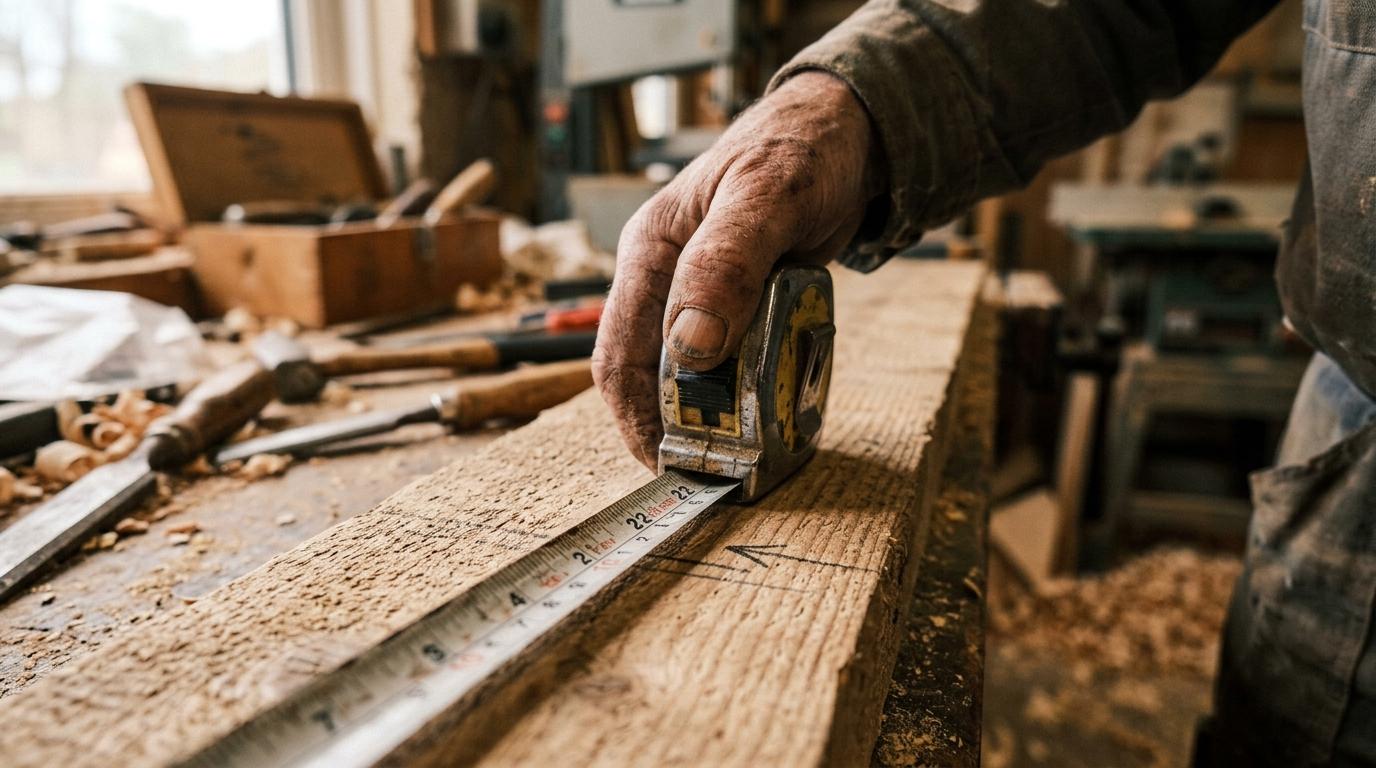
Metric is simple: learn it first
The metric side of a tape runs in millimetres with centimetre markers every 10 mm and a larger metre marker every 1000 mm. On a UK tape you'll also see small red marks every 16 inches (400 mm). Those are for standard timber stud spacing and can be ignored for general work.
How to read mm accurately
Always read to the nearest millimetre for woodwork and metalwork. For rough carpentry, centimetres are fine. The golden rule: always mark in millimetres, not fractions of centimetres: "324 mm" can't be misread, "32.4 cm" can. Write measurements as whole numbers whenever possible. If you must measure to half a millimetre, use a vernier caliper instead of a tape.
Never use the word 'and a bit'
A measurement isn't finished until it has a unit. "About 45" causes wrong cuts. "452 mm" doesn't.
Understand imperial fractions
The imperial side of a UK tape divides each inch into 16 equal parts: sixteenths. The marks get progressively shorter as the fraction gets smaller: the half-inch mark is the tallest (after the inch mark), quarter-inch next, then eighth-inch, then sixteenth. You read the fraction by counting how many marks past the last whole inch the measurement falls.
The hierarchy
From longest to shortest mark: 1 inch → 1/2 → 1/4 → 1/8 → 1/16. So if you count 3 small marks past the 7-inch line, you're at 7 and 3/16 inches. If you're at the medium mark exactly between 7 and 7.5, you're at 7 and 1/4 inches. The key skill is identifying the size of the mark you've landed on, not counting from zero each time.
Why does UK woodwork mix both?
Metric is standard for structural timber and sheet materials sold in the UK (which are metric sizes despite some old imperial names). But many older tools, screws, and American plans still use imperial. You need both.
Understand the hook
The metal hook at the end of the tape is deliberately loose by exactly its own thickness: it slides 1–2 mm in and out. This isn't a defect. It compensates for whether you're measuring from the outside of the hook (hooking onto an edge) or from the inside (butting the hook against a surface to measure inside a frame).
Why this matters
If you hook the tape over an edge and measure to a mark, the hook adds its thickness. If you butt the tape into a corner and measure, the hook slides back and the thickness disappears. Either way, the measurement is accurate. The hook compensates automatically. A hook that's riveted solid, or one where the rivets have come loose and allow extra movement, will give consistent wrong measurements. Check yours by measuring a known length from both hook positions and comparing.
Dropped tapes lose accuracy
Dropping a tape onto a concrete floor bends the hook. Even a slight bend of 1–2° introduces millimetre errors. Check the hook with a square after any significant drop.
Mark, don't measure twice
The most accurate way to transfer a measurement is not to read the tape at all: hold the tape against the work and mark directly from it. Place the hook on the reference edge, extend the tape to the desired length, and make a fine pencil mark (a V-shape with the point at the measurement) directly off the tape. This eliminates the "read the number, remember it, find the rule, mark it" chain where errors enter.
Marking conventions
Use a knife line rather than a pencil for woodwork cuts: a sharp knife scores across the grain and gives you a crisp line to place the saw against. Pencil lines can be 0.5–1 mm wide; a knife line is a fraction of that. For rough carpentry pencil is fine, but mark with a V or an X on the waste side of the line so you know which side to cut.
Burn a measurement
If your tape starts at zero 50 mm from the hook end, hook it onto nothing. Hook to the 50 mm mark instead, and add 50 to every reading. This avoids the wear zone at the tape's start. It's called "burning a measurement."