Why resistors have stripes
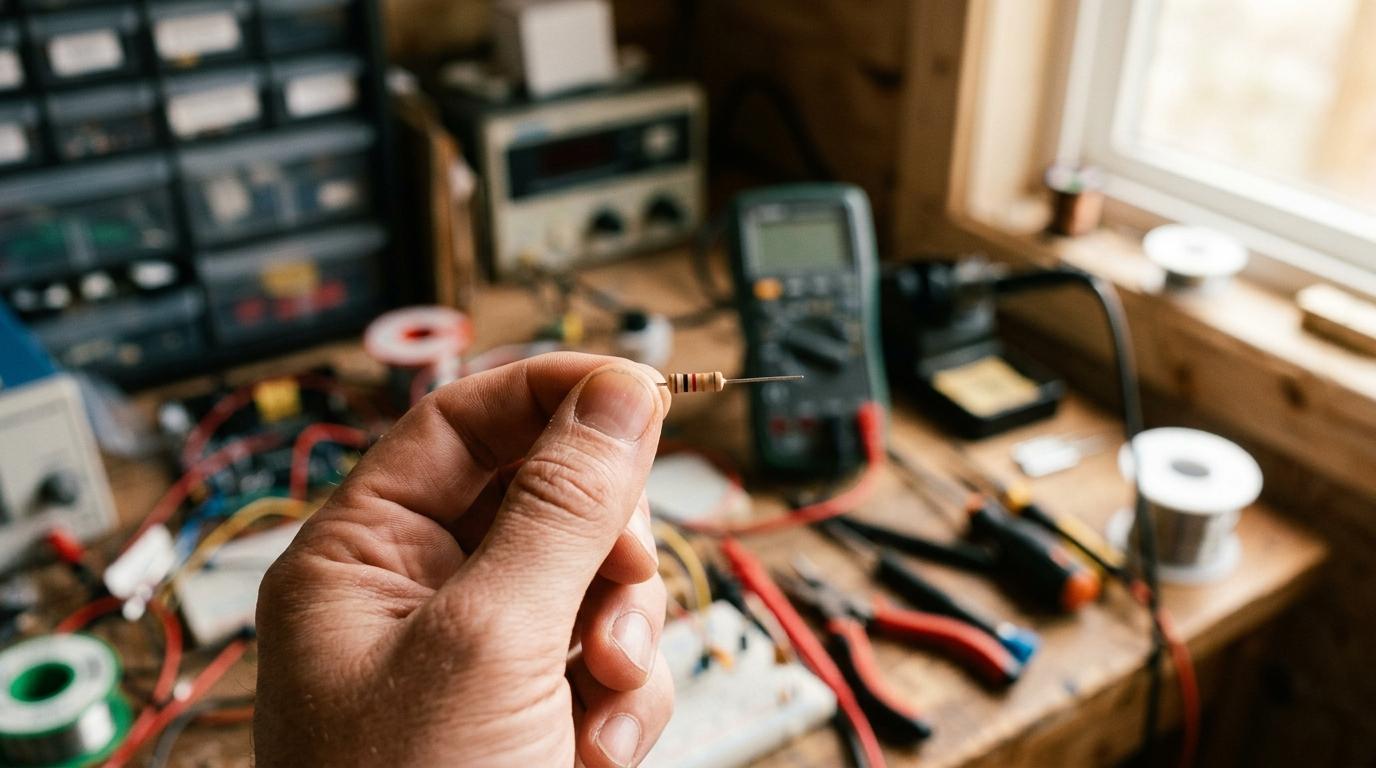
Resistors are tiny components that limit electrical current in a circuit. They're too small to print numbers on legibly, so manufacturers paint coloured bands around them. Each colour represents a digit or multiplier.
Once you know the code, you can read any standard resistor in about five seconds. It's one of those skills that makes you look competent at a workbench.
Grab a resistor now
Learning this hands-on is far faster than memorising it cold. Raid an old circuit board or buy a cheap assorted pack to practise with.
The colour-to-digit table
Every colour maps to a single digit, always in the same order. The sequence runs from black (0) up through brown, red, orange, yellow, green, blue, violet, grey, to white (9).
A phrase to remember the order
The classic mnemonic is: Better Be Right Or Your Great Big Venture Goes Wrong. The first letter of each word matches the colour in order: Black, Brown, Red, Orange, Yellow, Green, Blue, Violet, Grey, White.
The gold and silver bands
Gold and silver only appear as the last band. They indicate tolerance: how precise the resistor is. Gold means plus or minus 5%, silver means plus or minus 10%. A resistor with no tolerance band is assumed to be 20%.
Which end do you start from?
Hold the resistor so the tolerance band (gold or silver) is on the right. Read the remaining bands left to right. If no gold or silver band is visible, the bands are usually grouped closer to one end. Start from that end.
Reading a four-band resistor
Most common resistors have four bands. The first two bands are digits, the third is a multiplier (a power of ten), and the fourth is the tolerance.
A worked example
Suppose your resistor shows Yellow, Violet, Red, Gold. Yellow is 4, Violet is 7, Red as a multiplier means multiply by 100. So the value is 47 multiplied by 100: 4700 ohms (4.7 kΩ), with 5% tolerance.
The multiplier shortcut
The multiplier colour gives you the number of zeros to add after the first two digits. Red means add two zeros, orange means three zeros, yellow means four zeros. Black means add no zeros (multiply by 1), and gold means multiply by 0.1 for values below 10 ohms.
Use a calculator app to check yourself
Search for a resistor colour code calculator online, enter the colours you read, and compare. A few rounds of check-and-correct cements the table in memory faster than drilling it dry.
Five-band resistors and where to go next
Precision resistors use five bands. The first three bands are digits, the fourth is the multiplier, and the fifth is tolerance. The reading method is identical, with one extra digit before the multiplier.
Brown, Black, Black, Red, Brown reads as 100 multiplied by 100, giving 10,000 ohms (10 kΩ) at 1% tolerance. Once you're comfortable with four-band resistors, five-band ones feel natural within a day of practice.
Surface-mount resistors are different
Tiny SMD resistors printed with three or four digits use a straight numeric code, not colours. The number 472 means 47 followed by two zeros: 4700 ohms. That's a separate skill worth picking up once you've got the colour code solid.