Get a grip on both halves
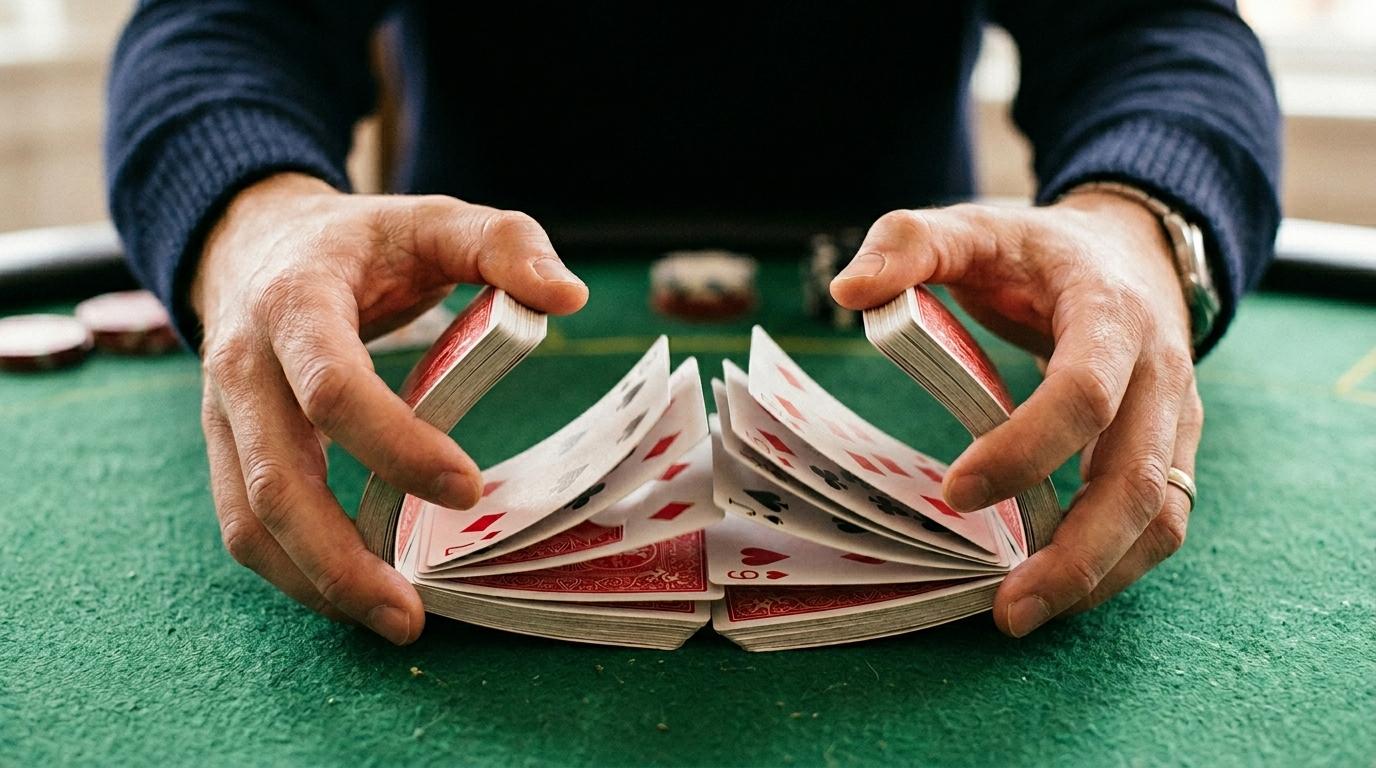
Start by splitting the deck into two roughly equal packets, about 26 cards each. Hold one packet in each hand, with your thumbs facing up along the inner edge and your fingers curled around the outside.
The bridge grip
Each packet sits in a bridge grip: your four fingers wrap around the long side, and your thumb rests on the inner short edge ready to release cards. The packets face each other, inner edges almost touching, angled slightly downward toward the table.
New deck tip
Brand new cards are slippery and stiff. Practise with a well-used deck first: the cards have just enough flex and grip to make learning much easier.
Release and interleave
Press the inner corners of both packets down onto the table, bending the cards slightly into an arch. Now slowly release cards from your thumbs alternately, a few from the left, a few from the right, letting them fall and weave together in the middle.
The thumb release
The key is gentle, even thumb pressure. You're not flicking: you're letting the cards spring free one small group at a time. Aim for one or two cards per release rather than big clumps. It'll feel awkward at first. That's normal.
How messy is okay
At this stage the interleave doesn't need to be perfect. Some cards may fall in groups of three or four. What matters is that cards from both halves are mixing together. Precision comes with repetition.
Don't rush the thumbs
Releasing both thumbs at the same speed matters more than releasing them fast. Slow and even beats quick and clumped every time.
Push through and square up
Once the cards have riffled together, the two halves are interleaved but still split into a V shape. Push them toward each other to close the V, then bridge the deck: arch it upward with both thumbs and let the cards cascade down flat as you release. This is the satisfying flourish you've seen dealers do.
Squaring the deck
After the bridge, tap all four edges of the deck against the table to square it up neatly. A well-squared deck is easier to deal, cut, and riffle again. Make squaring a habit at the end of every shuffle.
Skip the bridge at first
The bridge flourish is optional and adds bending stress to the cards. Get the riffle itself solid before adding it, or skip it entirely if you're using expensive playing cards.
Build muscle memory and go further
Seven riffle shuffles is mathematically enough to fully randomise a standard 52-card deck, a result proven by mathematician Persi Diaconis. For casual card games, three or four is plenty. Practise in short sessions of five minutes rather than grinding for an hour: your hands need rest to consolidate the motor pattern.
Common mistakes to fix
If cards bend or crease, you're arching too aggressively: reduce the downward pressure. If the halves won't interleave, your grip is too tight; relax your fingers slightly. If cards spray across the table, you're releasing too many at once: slow your thumbs right down.
Where to go next
Once the basic riffle feels natural, explore the Hindu shuffle, the overhand shuffle, and eventually the Faro shuffle, which requires perfectly even interleaving and is the foundation of many card magic effects.
Practice over a soft surface
A folded towel or cloth mat stops cards sliding away and reduces noise. It also protects the card edges, keeping your deck in good shape for longer.