Understanding the cube
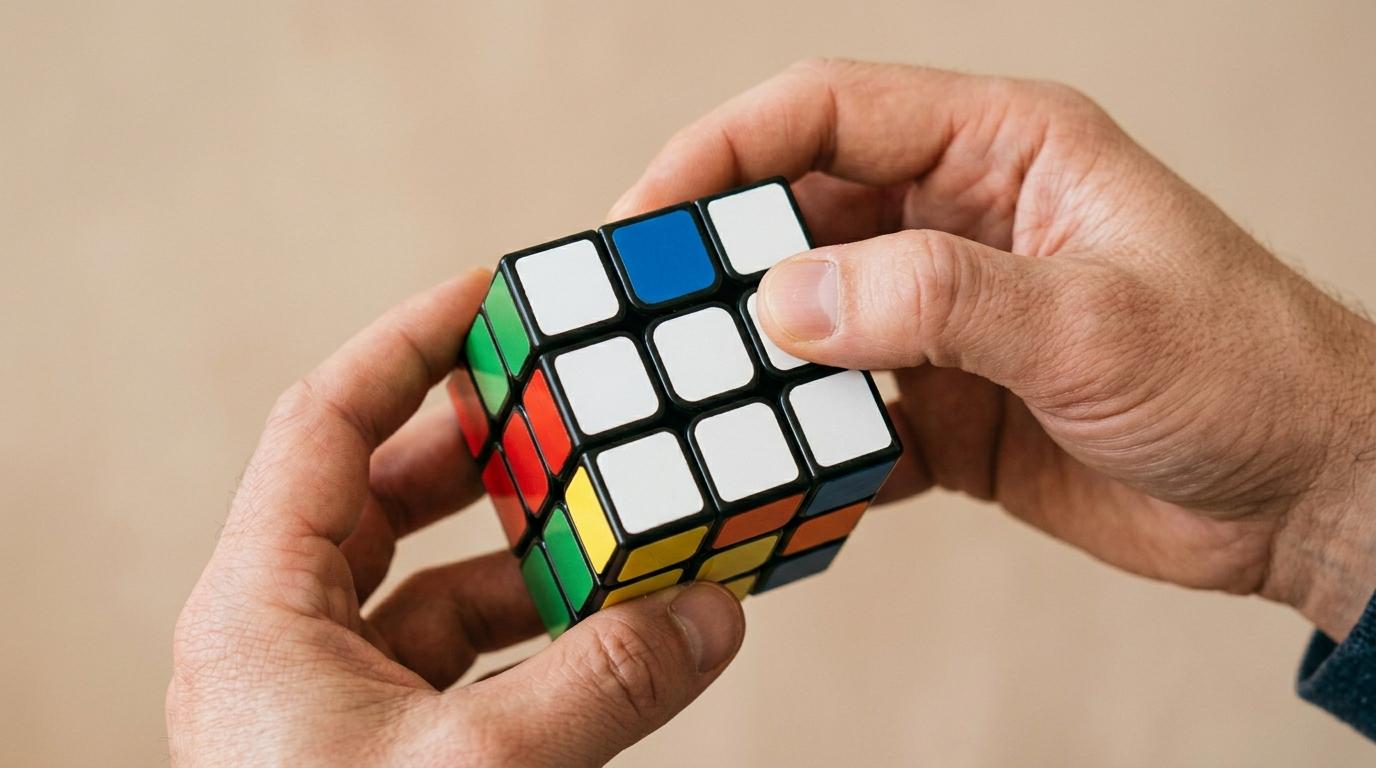
A 3×3 Rubik's Cube has 26 moving pieces: 8 corners, 12 edges, and 6 fixed centres. The key insight: each centre is fixed relative to the others. The white centre always faces the yellow centre. Centres tell you where each colour belongs. They never move.
Layer-by-layer solves the cube in three horizontal tiers: bottom (white), middle, and top (yellow). You memorise six short algorithms and you can solve any scramble. Expect your first solve to take 10–20 minutes; with practice, you'll reach 2 minutes.
The notation
Each face has a letter: F (front), B (back), R (right), L (left), U (up), D (down). A bare letter means a 90° clockwise turn. A prime (') means anti-clockwise. A 2 means 180°.
Pick a fixed orientation
Hold your cube with white on the bottom and yellow on top throughout. Rotating the whole cube mid-solve scrambles your mental model while learning.
Bottom two layers
1. White cross
Get four white edge pieces around the white centre. Each edge has two colours, and the non-white colour must match the adjacent face centre. There's no algorithm: solve it intuitively. It takes most beginners 5–10 minutes at first; after a week it drops to under a minute.
2. White corners
Place the four corner pieces to complete the white face. Find a white corner on the top layer directly above its target slot. Repeat R U R' U' until it drops into place (up to 5 times).
Right-hand algorithm
R U R' U' is the most important move sequence in beginner cubing. You'll use it constantly.
If a white corner is stuck in the bottom layer in the wrong position, use R U R' to pop it to the top layer, then re-insert correctly.
3. Middle layer edges
Find edge pieces on the top face that contain no yellow. Match the top-facing colour to the front centre, then insert it left or right:
Insert right: U R U' R' U' F' U F
Insert left: U' L' U L U F U' F'
Skip yellow edges
Any edge piece containing yellow belongs on the top layer. Leave it there and handle it in step 4.
Top layer
4. Yellow cross
The yellow face will show a dot, L-shape, line, or cross. Apply F R U R' U' F' until you get a cross. Dot → apply 3 times. L-shape → place the L at top-left, apply twice. Line → place horizontally, apply once.
5. Position yellow corners
Move corners to the right location (orientation doesn't matter yet). Find one corner already in its correct spot and hold it at front-right. Apply U R U' L' U R' U' L. Repeat until all four corners are correctly placed. If no corner is in position, apply once from any angle, then find the placed corner and continue.
6. Orient yellow corners
Hold a misoriented corner at front-right-top. Apply R U R' U' repeatedly until yellow faces up. Then rotate only the top layer to bring the next misoriented corner to front-right. Repeat. The top layer will look wrong mid-step: only watch the front-right corner each time.
Don't rotate the whole cube
Only use U moves between corners. Rotating the full cube mid-step undoes your work. Keep the bottom two layers fixed.
7. Cycle yellow edges
Cycle the four edge pieces until all match their centres. Hold the correctly placed edge at the back. Apply R U R' U R U2 R'. If no edge is in position, apply once from any angle to create a solved edge, then repeat with it at the back.
Going further
Once you can solve reliably, start timing yourself. A realistic first target is sub-5 minutes, then sub-2 minutes. Most people who practise consistently reach sub-2 minutes within a month.
When layer-by-layer flows naturally, look into CFOP, specifically F2L (First Two Layers), which pairs white corners with their matching middle-layer edges and inserts both simultaneously. It's the single biggest speed gain and a natural next step from what you already know.
Algorithms live in the hands
They feel abstract on paper. After 30 solves the moves start living in muscle memory rather than your head. Scramble, solve, repeat. No other method works as well.