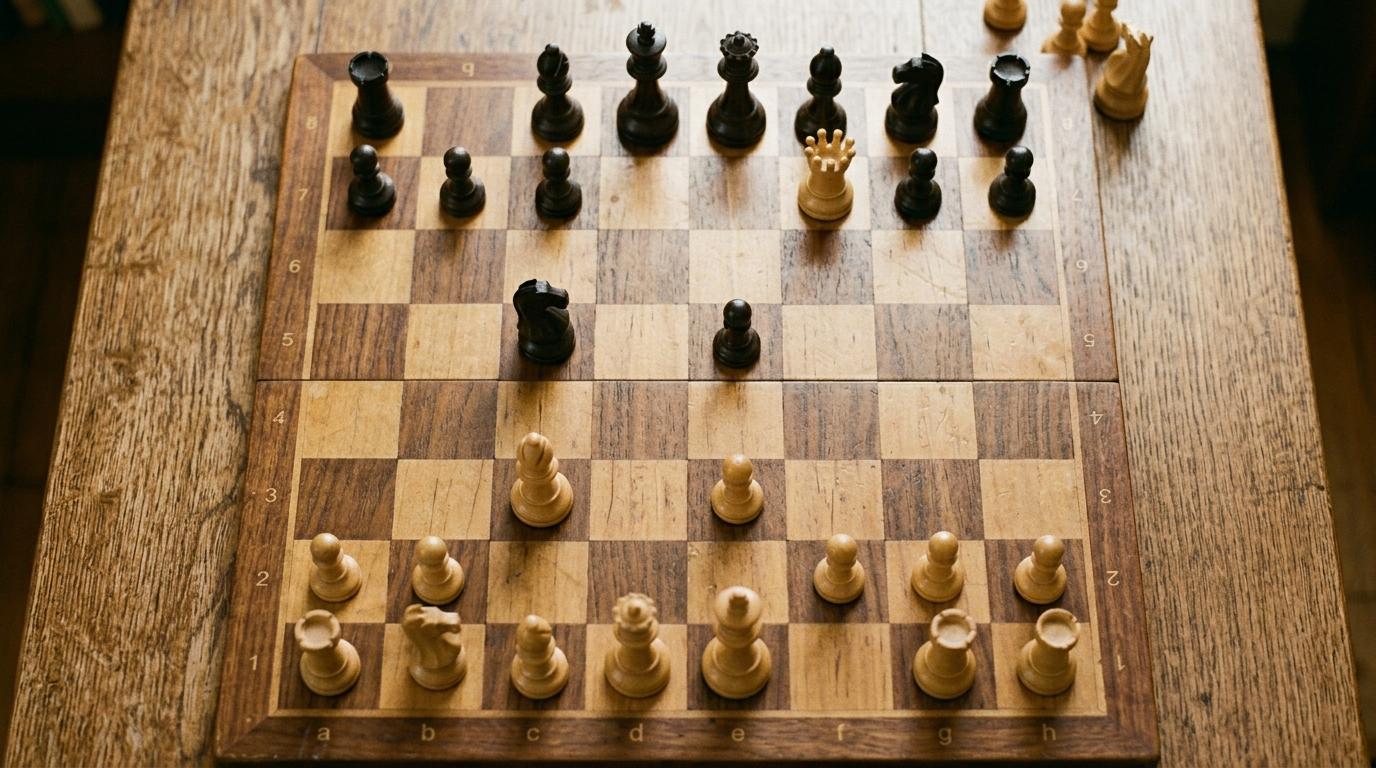
What is the Scholar's Mate?
The Scholar's Mate is the fastest possible checkmate in chess, ending the game in just four moves. It targets the weak f7 square: the pawn in front of the king, defended only by the king itself at the start of the game.
Why you need to know this
Beginners get checkmated by this pattern constantly, and it's humiliating when you don't see it coming. Once you understand the idea, you'll spot it instantly, and you can use it to rattle unprepared opponents.
Know both sides
Learn this as both attacker and defender. Recognising it early means you can punish greedy players who try it against you.
The four moves, one by one
White moves first. Here's the exact sequence that delivers the Scholar's Mate.
Move 1: Open the centre
White plays e4, advancing the king's pawn two squares. Black typically responds with e5, mirroring. This opens diagonals for the bishop and queen.
Move 2: Bring out the bishop
White plays Bc4, developing the light-squared bishop to point directly at the f7 pawn. Black often plays a natural developing move like Nc6 or Nf6 without noticing the threat building.
Move 3: The queen enters
White plays Qh5, swinging the queen to h5. Now the queen and bishop are both eyeing f7. If Black ignores this, the mate is one move away. A common mistake here is Nc6: it defends e5 but does nothing about f7.
Move 4: Checkmate
White plays Qxf7: checkmate. The queen takes the f7 pawn, supported by the bishop on c4. The black king has no escape square and no piece can block or capture the queen without being protected by the bishop.
It only works on inattentive opponents
Any player who knows this pattern will stop it easily. The Scholar's Mate is a trap, not a strategy. Rely on it too much and you'll stunt your own development.
How to defend against it
When you see an opponent's queen come to h5 early, your alarm bells should ring. The simplest defence is g6 after Qh5, attacking the queen and forcing it to retreat. Your bishop can then cover f7 from g7.
The Nc6 mistake
Many beginners instinctively play Nc6 on move three because it develops a piece and defends the e5 pawn. But it does nothing to stop Qxf7. Always ask yourself whether the f7 pawn is under threat before making a natural-looking move.
Better third moves for Black
After Qh5, the best responses are g6 (kick the queen), Nf6 (attack the queen and develop), or Qe7 (guard f7 directly). Each neutralises the Scholar's Mate and often leaves White's queen misplaced on the kingside.
Turn the tables
If your opponent plays Qh5 too early, you can punish them. After g6, Qf3, Nf6, their queen is poorly placed and you're ahead in development.
Practice and go deeper
The Scholar's Mate is your doorway into a bigger idea: piece coordination. The attack only works because two pieces aim at one weak square together. Every good chess tactic follows this same logic at a deeper level.
Where to practise
Play against a computer set to beginner difficulty and try executing the Scholar's Mate a few times. Then switch sides and practise defending it. Chess.com and Lichess both let you set up this exact position and drill it for free.
Next step after this
Once the Scholar's Mate feels obvious in both directions, study the Italian Game and the Fried Liver Attack. They build on the same f7 weakness idea with more depth.