Find the right stone
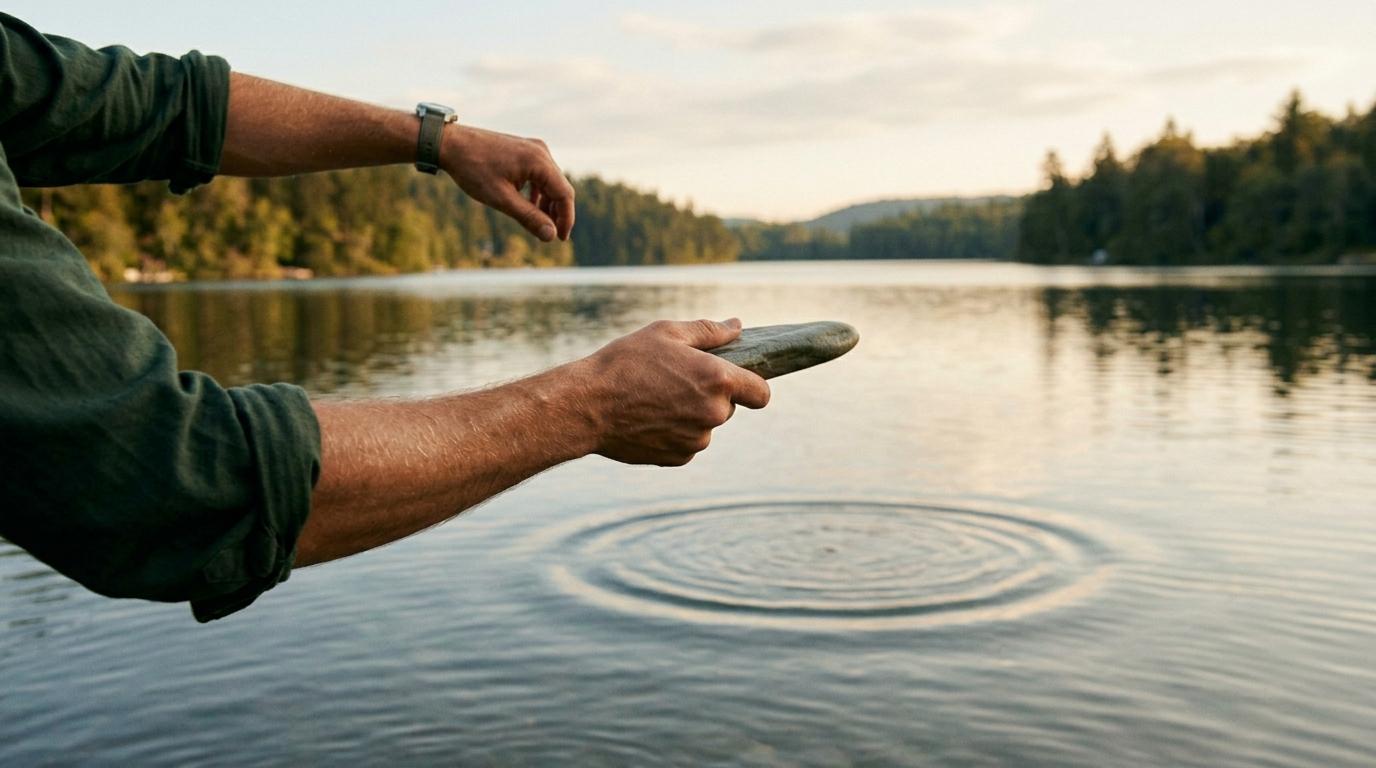
The stone makes or breaks the skip before your arm even moves. You want something flat, smooth, and palm-sized, roughly the size of a large biscuit and no thicker than your finger.
What to look for
Sedimentary rocks like slate, shale, or sandstone are ideal because they naturally form flat layers. Avoid round pebbles, chunky rocks, or anything jagged. Flatness is what lets the stone ride the surface tension rather than punching through it.
Weight matters
A stone that feels slightly heavy for its size skips better than a feather-light one. Too light and the wind or the first impact sends it tumbling.
Grip and stance
Hold the stone with your index finger curled along the edge and your thumb pressed flat on top. Your middle finger supports the underside. Think of it like gripping a frisbee in miniature: your index finger is what imparts the spin.
Get side-on to the water
Stand at the shore and turn so your non-throwing shoulder points toward the water. This gives you room to swing low and wide rather than throwing overhand, which drives the stone down instead of along the surface.
The release angle
Aim to release at roughly 20 degrees above the water, flatter than you instinctively want. Most beginners throw too steeply. Crouching low before you release helps you find the right angle naturally.
Spin is everything
A spinning stone is stable in the air, like a gyroscope. Flick your index finger hard at release to get that spin. Without rotation the stone wobbles and sinks on the first bounce.
The throw and follow-through
Swing your arm low and wide, keeping it parallel to the water's surface for as long as possible. It's more like a sidearm baseball throw than an overhand toss: your whole torso rotates into it.
The moment of release
Release when your arm is in front of your body, not out to the side. At the same time, snap your wrist and flick your index finger to generate spin. The two happen simultaneously and feel like one fluid movement once it clicks.
Calm water makes it easier
Choppy or rippled water is harder to skip on. Aim for flat, calm patches: the lee side of a bank, a sheltered bay, or still lake water on a windless morning. Early mornings on lakes are ideal.
Count your skips
Each time the stone touches the water counts as one skip. Three skips is a solid beginner result. Five to seven is competent. The world record is over 88.
Troubleshoot and go further
If your stone dives on the first touch, you're either releasing too steeply, not spinning enough, or both. If it skips once then sinks, your angle is fine but the spin needs work. Fix one variable at a time rather than changing everything at once.
Common fixes
Crouch lower to flatten your release angle. Slow your arm swing but accelerate the wrist snap: power comes from wrist speed, not arm strength. If you can't feel the spin leaving your finger, practise the flick in the air before throwing.
Going for distance
Once you're consistently hitting five or more skips, experiment with slightly heavier stones and more body rotation into the throw. Competitive skippers generate enormous wrist snap and throw nearly parallel to the surface from a low crouch.
Patience beats power
Throwing harder usually makes things worse at first. Nail the technique at moderate power, then gradually add speed. The physics does the work once your angle and spin are dialled in.