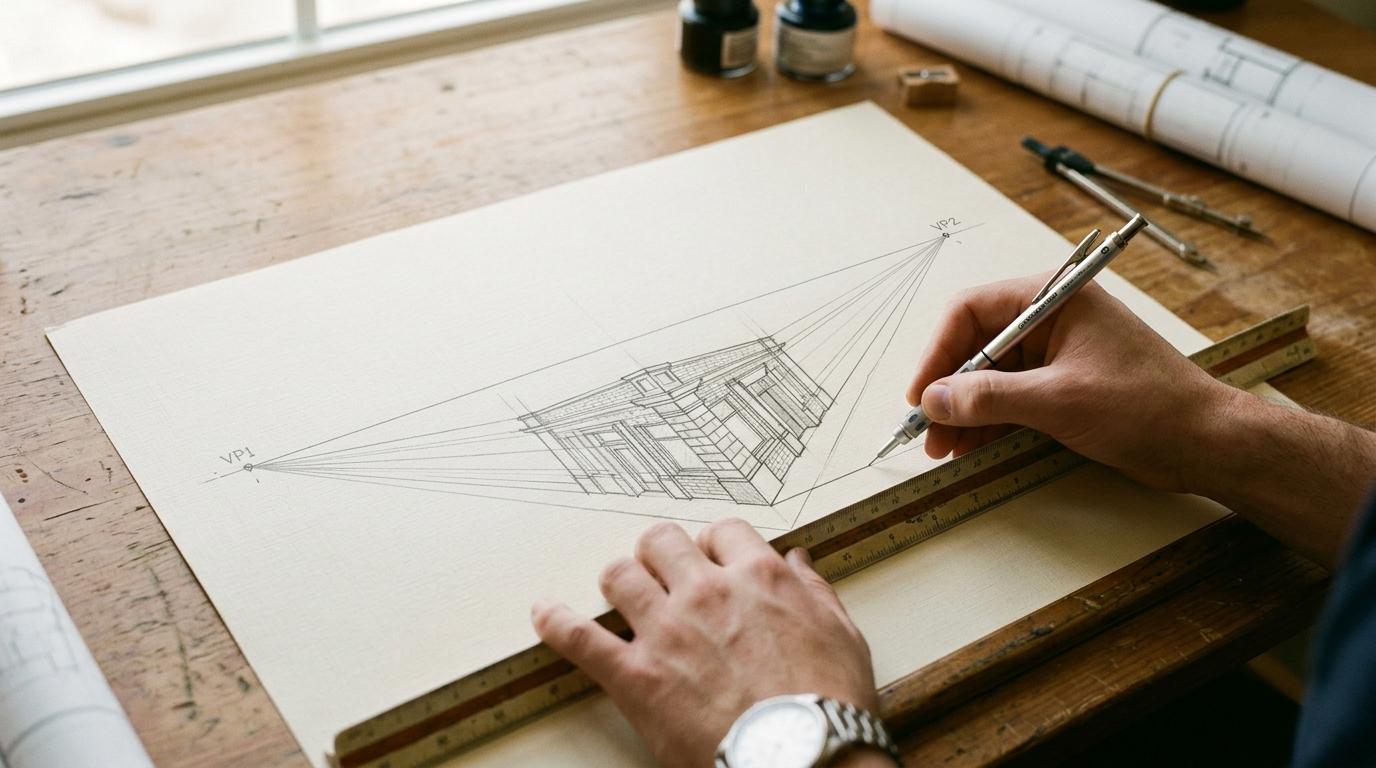
What two-point perspective is
One-point perspective (you may have tried this) has a single vanishing point: you're looking straight at a wall or corridor. Two-point perspective has two vanishing points, one on each side of the horizon line. This is how you draw the corner of a building, a room corner, or any object seen from an angle.
The horizon line
The horizon line represents your eye level. Everything above it is seen from below; everything below it is seen from above. Draw a horizontal line across the page first. It's the single most important line in the drawing.
Vanishing points are often off the page
Place your two vanishing points far apart, often at the edges or even beyond the edges of your paper. Beginners place them too close, which creates a distorted, fisheye look. The further apart the vanishing points, the more natural the perspective.
Draw your first building corner
- Draw the horizon line across the page. Mark VP Left (VPL) far left and VP Right (VPR) far right, on this line.
- Draw the corner edge: a vertical line somewhere near the centre of your page. This is the nearest corner of the building.
- Draw lines from the top of that vertical to each vanishing point. These are the top edges of your building's two visible walls.
- Draw lines from the bottom of that vertical to each vanishing point. These are the bottom edges.
- Add two more vertical lines: one on the left side (where that wall ends) and one on the right. These verticals should hit the converging lines you drew.
- Connect those far corners back to the vanishing points to form the far edges of each wall.
You have a box. Every rectangular object (buildings, furniture, vehicles) is a box in perspective.
Add windows, doors, and a roof
Any feature on a wall follows the same rules: its horizontal edges converge to the same vanishing point as the wall it's on. Its vertical edges are parallel to all other vertical edges.
Windows
To place a window: draw two lines from VPL across the wall face (top and bottom of the window). Then add two vertical lines for the sides. Every window on that face of the building follows the same converging lines.
A simple pitched roof
Find the midpoint of each gable end (the triangular end wall). Draw a vertical line from that midpoint upward: the ridge pole. Connect the top of the ridge pole to each front and back corner with converging lines toward your vanishing points. That's your roof plane.
Check with a ruler
If your lines aren't converging to exactly the same vanishing point, the drawing will feel wrong even if you can't identify why. Use a ruler and be precise. Perspective is geometry, not approximation.
Practice and next steps
Draw the corner of the room you're sitting in right now. Look at the ceiling where it meets the walls: those lines converge to your two vanishing points. Drawing from observation alongside a ruled framework is the fastest way to make perspective intuitive.