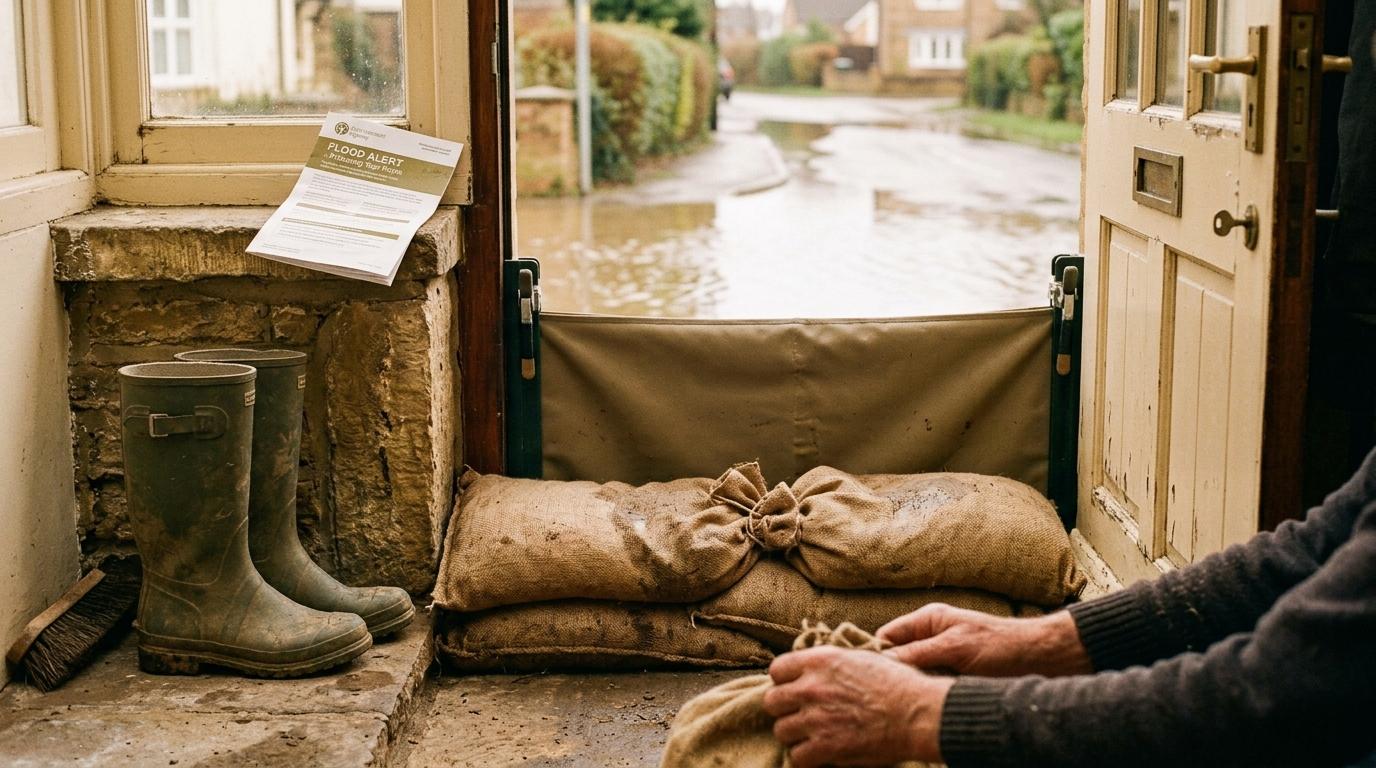
What to have ready
flooding is the UK's most common natural disaster. around 5.2 million homes in England alone are at risk from rivers, the sea, surface water, and rising groundwater. most flood events give some warning. what determines how well you come through one is whether you prepared before the water arrived.
Temporary flood barriers (door barriers or AquaSac-type bags)
£30–100The first line of defence for most properties. Door barriers slot into place across doorframes and can hold back significant water depth. AquaSac bags absorb water to form a seal without the weight and mess of traditional sandbags. Buy to fit your widest external door. Measure before ordering. Check the product's rated head height against your risk level.
Affiliate link. We may earn a small commission.
Sandbags and filler (or pre-filled sandbag delivery service)
£20–60Effective for blocking secondary entry points, protecting airbricks, and redirecting flow around the property. Empty hessian bags with loose sand or soil are cheaper and more flexible than pre-filled. Pre-filled delivery services exist in high-risk areas, so identify a supplier before you need one. Fill bags two-thirds full and fold the top over.
Affiliate link. We may earn a small commission.
Submersible pump (with 10m hose)
£40–80If water gets in, you need to move it out faster than it's arriving. A submersible pump drops into standing water and discharges through a hose to a drain or outside the building. The 10m hose gives enough reach to a street drain. Run it from a generator or battery inverter if mains power is off. Check the flow rate: litres per hour, not just watts.
Affiliate link. We may earn a small commission.
Waterproof document wallet or case
£10–20Insurance documents, passport, driving licence, mortgage papers. A rigid waterproof case keeps them readable after everything else is ruined. Keep it somewhere you can grab in under two minutes.
Affiliate link. We may earn a small commission.
Wellington boots and waterproof trousers
£20–50For deploying barriers, moving sandbags, and evacuating through shallow water. Knee-length wellies cover most scenarios; thigh-length for serious flooding. Waterproof trousers matter because floodwater frequently contains sewage, and you don't want it on your skin.
Affiliate link. We may earn a small commission.
Battery-powered or hand-crank radio
£20–40When the power is out and the phone signal is overloaded, a radio is how you receive Environment Agency updates and local authority instructions. Keep spare batteries. A DAB/FM model covers all UK emergency broadcasts.
Affiliate link. We may earn a small commission.
Dry bags for valuables
£10–20Phones, chargers, medications, and anything irreplaceable go into dry bags when you're moving fast. Roll-top closure, rated to at least 5 litres. A set of three different sizes covers most needs.
Affiliate link. We may earn a small commission.
Where to buy (UK)
- Amazon UK: Widest range of barriers, pumps, and dry bags. Compare reviews carefully on flood barriers before buying
- Screwfix: Good stock of pumps, wellies, and some flood barriers; useful if you need something the same day
- B&Q: Sandbags, submersible pumps, and waterproofing products; click-and-collect available at most branches
- Direct Flood Control: UK specialist for flood barriers, airbrick covers, letter box seals, and toilet bungs. Best range for serious property protection
Some links are affiliate links. Airgap.life may earn a small commission at no extra cost to you.
Never walk or drive through floodwater
30cm of fast-moving water can knock an adult off their feet. 60cm can sweep a car away. floodwater is frequently contaminated with sewage and chemicals, and conceals hazards underfoot. if it's flooded, don't attempt it. turn around and find another route, or stay where you are.
Know your risk
Check your flood risk
the Environment Agency's long-term flood risk service (check-long-term-flood-risk.service.gov.uk) lets you enter any UK postcode and see the flood risk for that property. risk is categorised as high (greater than 1-in-30 chance per year), medium (1-in-100), low (1-in-1,000), or very low. a 1-in-100 risk sounds reassuring. over a 25-year mortgage it becomes a 22% cumulative probability. four types of flooding affect UK properties: fluvial (river overflows), surface water (overwhelmed drains), groundwater (rising water table), and coastal. a property can be at risk from more than one source simultaneously.
Warning systems
the Environment Agency operates a free flood warning service: Floodline. sign up at gov.uk/sign-up-for-flood-warnings or call 0345 988 1188. once registered, you receive automatic calls, texts, or emails when warnings are issued for your area. there are three escalating warning levels, each requiring a faster response. the system is reliable; the mistake most people make is registering but not acting until it's too late.
Insurance
standard home insurance covers flooding as a named peril under both buildings and contents policies. read your policy documents: some carry high excess charges on flood claims; some exclude properties that have previously flooded without subsequent resilience improvements. if your insurer offered flood cover at an increased premium and you declined it, you may have limited recourse in a claim. the Flood Re scheme (established 2016) allows insurers to reinsure high-risk properties through a government-backed pool, keeping premiums manageable for homes that would otherwise be uninsurable. check floodre.co.uk to see whether your property is eligible.
Flood memory
properties that flood once usually flood again. local authority historical flood records, Land Registry data, and the Flood Re eligibility database all carry this history. when buying a property, ask directly: has this flooded? when? from which source? what was the damage? sellers are required to disclose material facts; flooding qualifies. the Environment Agency's risk map does not capture every property that has flooded. local knowledge and historical council records often tell a more accurate story than the official risk category suggests.
History
UK flooding has shaped the modern warning and insurance system in direct response to disaster. the east coast floods of January–February 1953 killed 307 people in England and remain the deadliest peacetime flood on record; they prompted the establishment of the North Sea Flood Warning System and the sea defences protecting much of the east coast today. the 2007 summer floods inundated large parts of Gloucester and Tewkesbury and left 350,000 people without running water for up to 17 days, exposing serious weaknesses in the protection of critical infrastructure. the 2015–16 winter floods devastated communities across Yorkshire, Lancashire, and Cumbria, including Carlisle's second major flood in a decade, and prompted a £2.5bn flood defence investment programme. the February 2020 floods (Storms Ciara, Dennis, and Jorge in rapid succession) broke rainfall records across Wales and the Midlands. Flood Re launched in 2016 between these last two periods of crisis, acknowledging that conventional insurance markets could not serve high-risk UK properties at scale without government backing.
What to do
After the flood
returning home after a flood is not straightforward. do not re-enter until the authorities confirm it is safe and gas and electricity have been checked by qualified engineers. floodwater leaves behind contaminated silt, hidden structural damage, and, in older properties, disturbed asbestos from floor tiles and pipe insulation. wear waterproof gloves and boots throughout the clean-up. ventilate the property as quickly as possible. bag contaminated materials for disposal through your local council. damp and mould develop rapidly without thorough drying; specialist drying equipment, usually arranged through your insurer, may be needed for weeks. log all damage with your insurer before removing or discarding anything.
Risk checked
Used the Environment Agency Flood Map to confirm your flood zone, risk category, and which flood types apply to your property and postcode.
Signed up for warnings
Registered with Floodline (0345 988 1188 or gov.uk/sign-up-for-flood-warnings) for automatic flood alerts by phone, text, or email.
Kit assembled
Flood barriers, submersible pump, waterproof document case, dry bags, wellies, waterproof trousers, and battery radio all sourced and stored somewhere accessible.
Home protected
Door barriers fitted or rehearsed, airbrick covers sourced, toilet bungs installed, entry points identified, and fuse box location confirmed.
Evacuation plan in place
Two exit routes known, go-bag packed, medications listed, a contact person outside the area briefed, and local emergency rest centre locations noted.
Property resilience improved
Permanent resilience measures considered or implemented: raised electrical sockets, flood-resistant flooring, non-return valves on drains, flood-resistant door and window sets.
- Environment Agency Floodline: Free flood warning service: sign up at gov.uk/sign-up-for-flood-warnings or call 0345 988 1188
- National Flood Forum: UK charity supporting flood-affected communities, with practical guidance and local flood group connections (floodforum.org.uk)
- Property Flood Resilience Action Plan: Government-backed guide to protecting your home from flood damage permanently (gov.uk/guidance/flood-risk-and-coastal-change)
Qualifications
British Red Cross First Aid
Essential for any emergency scenario. Courses available nationwide at redcross.org.uk
Best resources
Community
Reader tips
No tips yet. Be the first to share what worked for you.
Share a tip
Sign in to share what worked for you.