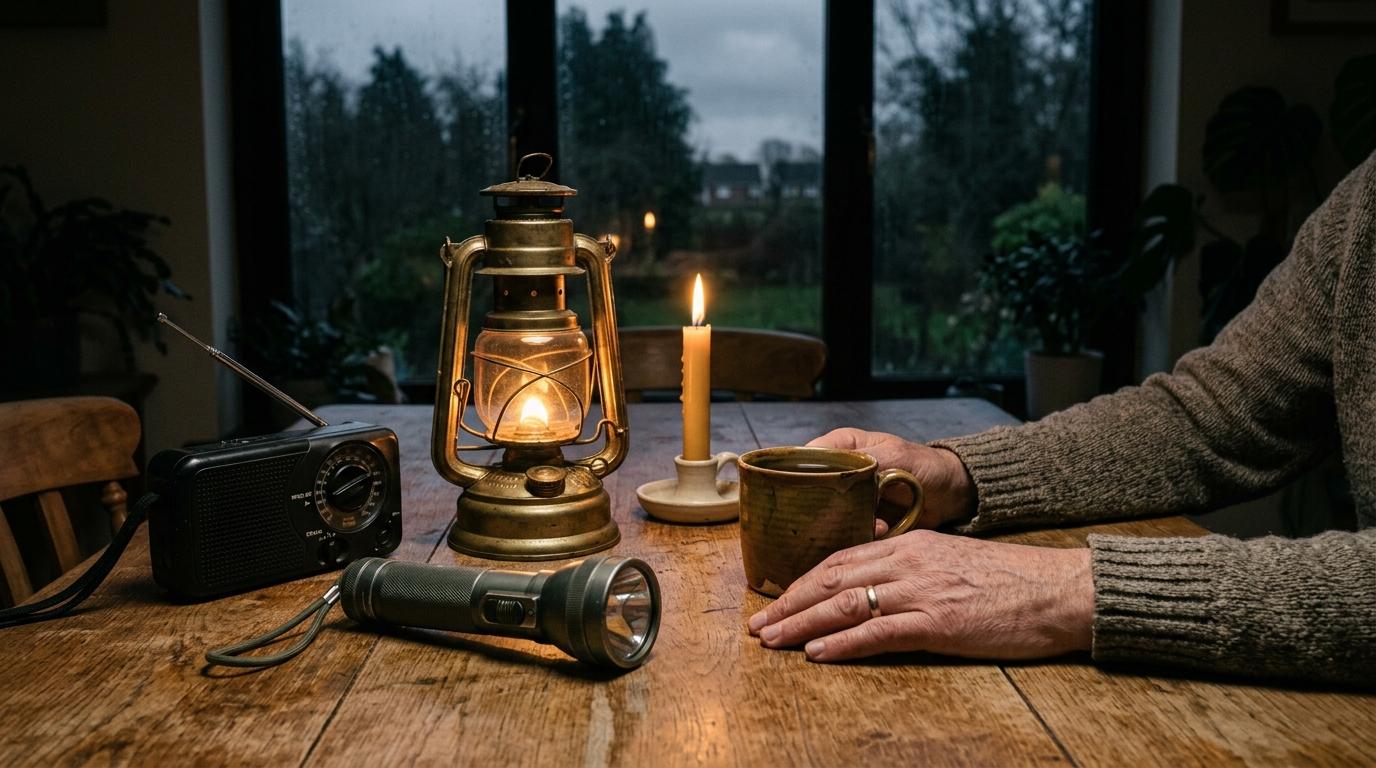
What to have ready
a power cut usually arrives without warning. most people discover they have no torch only after they need one, which is exactly the wrong time to find out. this list is what to have in one cupboard, checked once a year, before it happens.
Rechargeable LED torch: head torch and lantern
£15–35a head torch keeps your hands free for everything you need to do in the dark: checking the fuse box, finding blankets, settling children. a separate lantern lights a room without requiring anyone to hold it. buy a USB-rechargeable model so the same power bank that charges your phone charges your torch. Petzl and Silva make reliable head torches; Goal Zero and BioLite for lanterns.
Affiliate link. We may earn a small commission.
Portable power bank (20,000mAh or more)
£25–40keeps phones, torches, and small devices running through a long outage. a 20,000mAh bank gives a modern smartphone four to five full charges. keep it topped up as a habit: a flat power bank is decorative. Anker and Baseus are reliable at this price point.
Affiliate link. We may earn a small commission.
Battery-powered or wind-up radio (DAB/FM)
£20–40when the internet is down and your phone is on low power, the radio still works. BBC Radio 4 carries emergency broadcasts; local stations carry updates from your network operator. a wind-up or solar model means no batteries to run flat. Roberts and Sangean make solid UK models.
Affiliate link. We may earn a small commission.
Camping stove and gas canisters (minimum two)
£25–50most UK homes have electric hobs or combi boilers that need mains power, and neither works in a cut. a gas camping stove means hot food and hot drinks regardless of what the grid is doing. keep a spare canister: one runs out faster than you expect. use outdoors or in a well-ventilated space only: gas stoves produce carbon monoxide.
Affiliate link. We may earn a small commission.
Thermal flask, 1 litre, stainless steel
£15–25fill it with boiling water as soon as the cut starts, before the boiler loses its residual heat. a good stainless flask keeps water hot for 12 hours or more, useful for drinks, refilling a hot water bottle in the night, or preparing baby formula. avoid vacuum flasks with glass liners. Stanley and Klean Kanteen are worth the price.
Affiliate link. We may earn a small commission.
Battery-powered LED lantern
£12–25better than candles in almost every situation: no fire risk, no drips, no fumes. a collapsible camping lantern provides enough light to cook, read, or move around safely. LED means batteries last far longer than older bulb types. a model with a hook or handle can hang from a fixture or sit on a shelf.
Affiliate link. We may earn a small commission.
Uninterruptible Power Supply (UPS) for router and critical devices
£50–80a UPS is a battery that kicks in automatically when mains power fails, keeping connected devices running for 30 to 90 minutes depending on load: your router, modem, or a medical device. useful if you work from home, need internet for emergency communications, or have powered medical equipment in the house. APC and EcoFlow make reliable domestic models. not essential for everyone, but worth serious consideration.
Affiliate link. We may earn a small commission.
Where to buy (UK)
- Amazon UK: widest range, fastest delivery, easiest to compare specs side by side
- Screwfix: good for torches and lanterns; same-day collection from most branches
- Go Outdoors: best for camping stoves, gas canisters, and thermal flasks; price-match policy
- Argos: power banks, radios, and lanterns; same-day store collection available
Gas canisters: buy in person where possible. Delivery restrictions on pressurised goods mean online postage is sometimes unavailable.
Some links are affiliate links. Airgap.life may earn a small commission at no extra cost to you.
The 105 number
call 105, free from any phone including a mobile with no data, to report an outage or get an update from your local network operator. it connects you directly to the team responsible for your street, not a general call centre. it works when your internet is down. most people have never heard of it.
How the system works
most of what happens in a power cut is predictable. knowing the system means you spend less time guessing and more time making sensible decisions.
Your electricity supply
the UK electricity grid is divided into regional networks, each managed by a Distribution Network Operator (DNO). the DNO, not your energy supplier, is responsible for the physical wires bringing power to your home. in a fault outage, you contact the DNO. your energy supplier cannot fix an infrastructure problem.
cuts come in two types. a planned interruption is scheduled maintenance; your DNO must give at least two days' written notice, and it is listed on their website. a fault outage is unplanned: storm damage, equipment failure, an accident on a line. under Ofgem's guaranteed standards, if a fault outage lasts more than 18 hours, domestic customers are entitled to £75 compensation, plus £35 for every additional 12-hour period, up to a cap. you have to claim it. most people don't.
Food safety
a fridge stays safe for four hours if the door is kept closed. a full chest freezer holds its temperature for 24 to 48 hours; a half-empty upright freezer for around 12 hours. after those windows close, meat, fish, dairy, and cooked food that has spent more than two hours above 5°C should be discarded. never refreeze anything that has fully thawed. eat fresh food first (fruit, salad, bread, anything that doesn't need refrigerating), then canned goods, then whatever the camping stove can handle.
Heating without electricity
most UK combi boilers require mains electricity to run the pump and controls, even when the gas supply is working. no power means no central heating and no hot water from the taps. a gas hob still functions (the electronic igniter may not, so keep a lighter nearby). close internal doors to retain heat in occupied rooms; an unheated hallway is just volume to lose warmth into. layer up before you're cold, not after. a hot water bottle filled before the boiler cools covers most overnight scenarios. a wood burner is the obvious long-term answer to all of this, which is why they continue to sell so many of them.
Medical equipment
if anyone in the household relies on electrically powered medical equipment (a CPAP machine, home oxygen concentrator, or dialysis machine), register with your DNO through the Priority Services Register before an outage happens. registered customers receive advance notice of planned cuts, a priority response during fault outages, and in some cases a welfare check if the outage runs long. registration is free. contact your DNO directly or ask your energy supplier to add you. do not wait until there is a problem.
A brief history of the lights going out
Nationalisation
Britain's electricity supply nationalised under the British Electricity Authority, unifying a patchwork of local companies with incompatible voltages. Rural electrification continued for another decade. Parts of Scotland and Wales weren't fully connected until the late 1950s.
The three-day week
The Heath government restricted commercial electricity use to three working days per week to preserve coal stocks depleted by the miners' strikes. Rolling household cuts, often unannounced. Candles sold out nationwide. BBC television ended at 10:30pm by government order.
9 August: the grid event
A lightning strike caused the near-simultaneous loss of Hornsea offshore wind farm and Little Barford gas power station, 1.4 gigawatts gone in seconds. Over a million homes lost power. Trains stopped mid-journey. For most customers, it lasted around 45 minutes.
What to do
Going further
First power cut handled
Day 1used 105. kept the fridge closed. kept everyone calm. made hot drinks. made it through the night.
Kit assembled
Week 1–2torch, power bank, radio, stove, flask, and lantern bought and stored together. power bank kept charged as a habit.
Registered with Priority Services
Week 2if applicable: any household member with a medical device or vulnerability is registered with the local DNO. free and takes ten minutes.
72-hour plan in place
Month 1food, water, warmth, and communications covered for 72 hours without mains power. plan is written down and every member of the household knows it.
Generator or solar backup considered
Month 2–6a petrol generator (outdoors only) or a solar generator with battery storage provides longer-term resilience. considered in proportion to household needs and budget.
Household drilled and ready
Ongoingeveryone knows where the kit is, how to use the stove, and what the plan is. kit checked and power bank topped up annually.
Resources worth knowing
- UK Power Networks: the largest UK DNO; their website and app provide real-time outage mapping, Priority Services Register sign-up, and compensation claims for London, the south-east, and east of England
- Priority Services Register: free registration for vulnerable customers with any UK DNO; provides advance notice of planned cuts, priority restoration, and welfare checks; register via your DNO or energy supplier
- gov.uk/prepare-for-emergencies: UK government official emergency preparedness guidance; practical, updated regularly, and covers power cuts within a broader household resilience framework
If you want to go further
British Red Cross Emergency Preparedness
Online resources and in-person courses covering emergency planning for households and communities. Free content at redcross.org.uk.
Red Cross Community First Aid
One-day practical first aid course. Worth doing alongside any resilience preparation; emergencies rarely arrive alone.
Best resources
Community
Reader tips
No tips yet. Be the first to share what worked for you.
Share a tip
Sign in to share what worked for you.