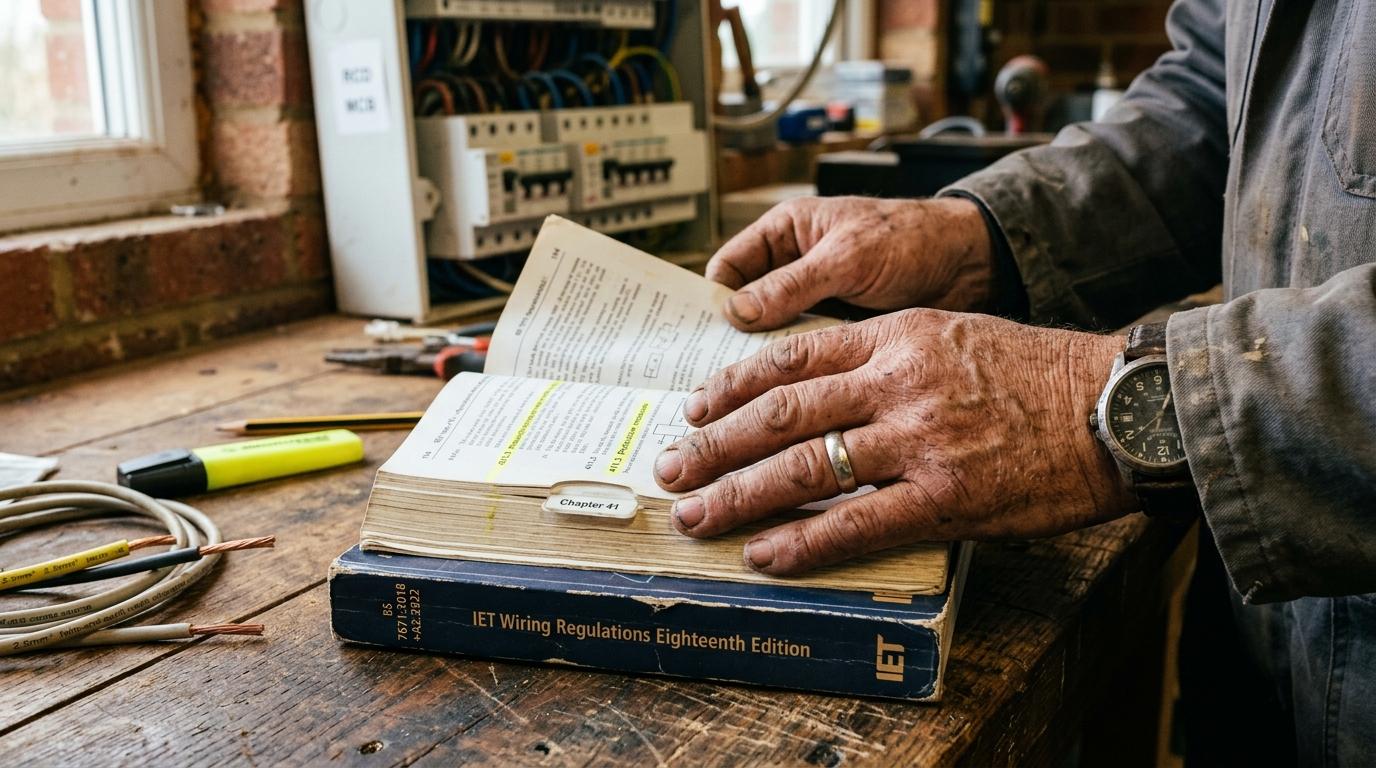
What the regs are, and what they aren't
Read this before anything else
This course teaches the content of a standard and prepares for a knowledge exam. It does not qualify you to carry out electrical installation work. Getting mains electrical work wrong kills people and burns houses down, and no amount of reading changes that. Nothing here overrides the rule that if you are not competent to do a job safely, you employ someone who is.
BS 7671, the IET Wiring Regulations, is the national standard for electrical installations in the UK. Every professional electrician works to it. It is not itself law: it is a British Standard, and compliance with it is the accepted way of demonstrating that an installation meets the safety requirements the law does impose. That distinction matters, and it is the first thing the exam expects you to have straight.
The three things people confuse
What the 2382 exam is
City & Guilds 2382, "Requirements for Electrical Installations", tests your knowledge of BS 7671. It is open book, multiple choice, sat at an approved centre, and open to anyone: no prior qualification or experience is required to enter. It is the regulations component that appears inside every electrician's qualification portfolio, which is why it is taken by so many people.
What it is not is a licence. Passing it does not make you an electrician, does not permit you to carry out notifiable work, and does not let you self-certify anything. Doing and signing off installation work requires a full installation qualification such as C&G 2365 or an NVQ, demonstrated on-site competence, and registration with a Part P competent person scheme (NICEIC, NAPIT and Stroma among them). 2382 is one brick in that wall.
BS 7671, the current edition, on paper
£80–110Required. You take your own copy into the exam, and buying it early is the point: the whole skill being tested is finding things in this book quickly, which only comes from handling it for weeks beforehand. Buy the current edition and amendment. An out-of-date copy is worse than useless in an exam written against the current one. The IET's On-Site Guide is a useful companion but is not a substitute.
How the book is organised
This is the step that decides whether you pass. The exam is open book, so it cannot test recall: it tests whether you can use the standard. Candidates who fail overwhelmingly fail on time: they know roughly where something lives and spend four minutes confirming it. Learn the architecture and that collapses to twenty seconds.
The seven Parts
The Appendices, and the numbering
Much of what you look up in an exam lives in the Appendices rather than the Parts: cable current-carrying capacity and voltage drop tables, maximum earth fault loop impedance values, standard circuit arrangements, and the model certificate forms. Learn which appendix holds which table and you have removed a large fraction of the searching.
The numbering is systematic once you see it. A regulation number like 411.3.3 reads as Part 4, Chapter 41, Section 411, then the sub-requirement, so the first digit alone tells you which Part you are in, and therefore whether you are in the right half of the book. Getting fluent with that is worth more than memorising any individual regulation.
Tab the book, and use it until it falls open
Sticky-tab the Parts, the key tables and the Appendices, then practise looking things up against past questions until you stop thinking about where to go. Most centres permit a copy that is tabbed and highlighted but not written in with additional notes. Confirm the exact rule with your centre before exam day, because the requirements are specific and a non-compliant copy can be refused.
Protection: shock, overcurrent, earthing
Part 4 is where most of the technical weight sits, and the reasoning underneath it is more memorable than the regulation numbers. Almost everything reduces to two questions: how do we stop current passing through a person, and how do we stop a fault setting the building on fire?
Protection against electric shock
Earthing and bonding: the distinction that catches people
Earthing connects exposed-conductive-parts of the installation to earth so that a fault current can flow and trip a protective device. Bonding connects extraneous-conductive-parts (incoming metal water and gas pipes, structural steel) together so that everything a person might touch simultaneously sits at the same potential. Earthing clears the fault; bonding stops you becoming the path between two different potentials while it happens. The exam tests both the concept and the conductor sizing.
Overcurrent
Two distinct things travel under one word. An overload is too much current in a healthy circuit: a slow build, protected by matching the device rating to the cable's current-carrying capacity. A short circuit or fault current is a sudden very large current, and the device must have sufficient breaking capacity to interrupt it safely. Cable selection ties these together: current-carrying capacity from the tables, adjusted by correction factors for grouping, ambient temperature and insulation, then checked against voltage drop limits.
Inspection, certification, and the exam
What must be recorded
Part 6 and the model forms in the Appendices cover verification. New work gets an Electrical Installation Certificate; a small addition to an existing circuit may be covered by a Minor Electrical Installation Works Certificate; an assessment of an existing installation produces an Electrical Installation Condition Report (EICR), with observations coded by severity: broadly, C1 for danger present, C2 for potentially dangerous, C3 for improvement recommended, and FI where further investigation is needed. Knowing which document applies to which job is examinable, and it is also the paperwork that makes an installation defensible afterwards.
Sitting the exam
2382 is an open-book, multiple-choice exam of roughly two hours, sat at a City & Guilds approved centre, typically for something in the region of £100–£180 depending on the centre and whether you buy tuition with it. There is no entry requirement. Book through a local FE college or a private training provider; the C&G centre finder lists approved ones. Confirm the current course code when you book, because it changes with each amendment to BS 7671 and you must sit the version matching the copy you bring.
You're here: the regulations
This courseWhat BS 7671 is and how it relates to Part P and to competence. The seven Parts, the Appendices and the numbering system. Shock, overcurrent, earthing and bonding. Certificates, EICRs and observation codes.
C&G 2382: Requirements for Electrical Installations
Self-study + examOpen-book multiple-choice exam at an approved centre, no entry requirement. Certifies knowledge of BS 7671, a component of an electrician's qualifications, not a licence to work.
C&G 2365 Level 2 and 3, or an NVQ
1–3 yearsThe actual installation qualifications: classroom and assessed practical work, normally at a college and alongside real site experience. This is the route that leads towards being an electrician.
C&G 2391, and scheme registration
After experience2391 covers inspection, testing and certification and expects real experience behind it. Registration with a Part P competent person scheme (NICEIC, NAPIT, Stroma) requires assessment of your work and is what permits self-certification of notifiable work.
Best resources
- IET Electrical channel: amendment briefings and regulation explainers
- eFIXX: BS 7671 walkthroughs aimed at working electricians
What to have on the desk
Community
Reader tips
No tips yet. Be the first to share what worked for you.
Share a tip
Sign in to share what worked for you.