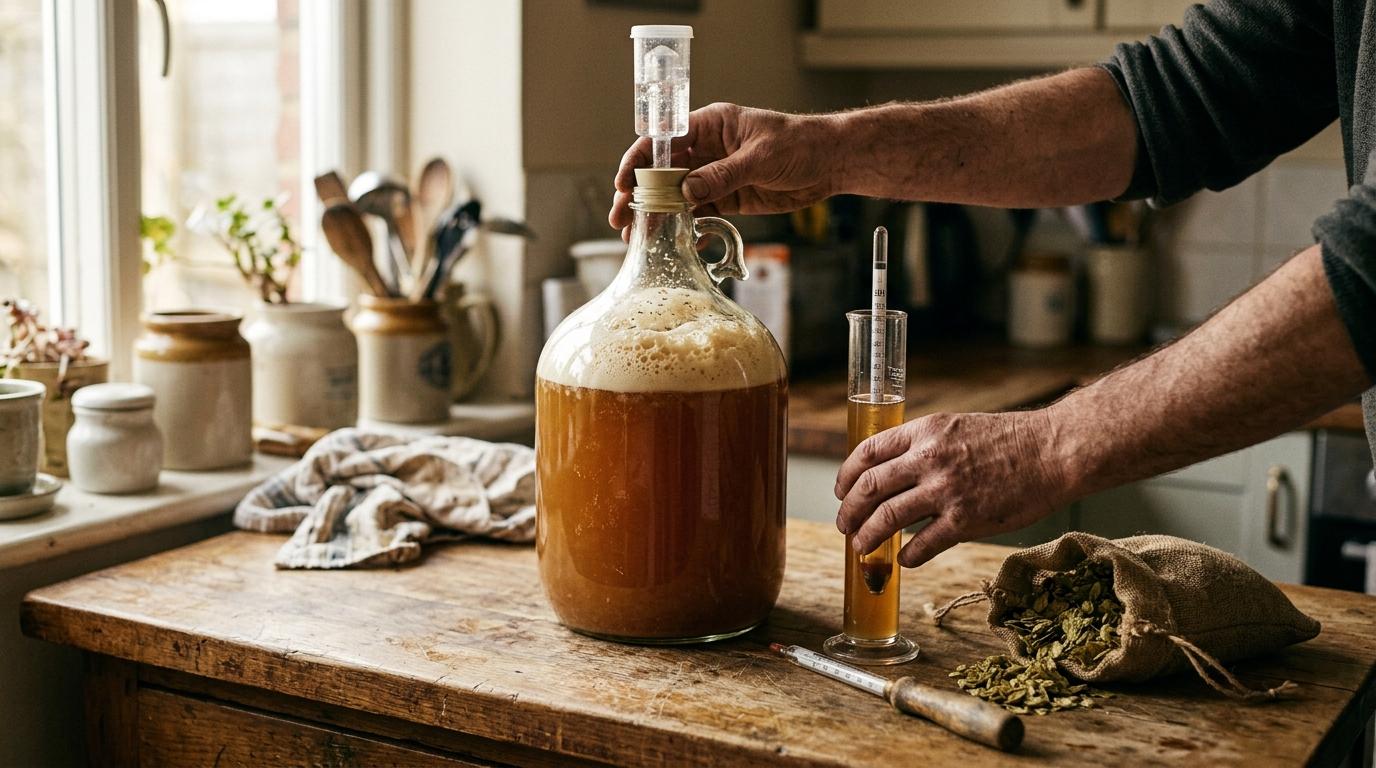
Equipment & ingredients
Brewing beer at home is simpler than it looks. The flavour comes from four ingredients. The skill is mostly about cleanliness and patience. This course covers extract brewing, using pre-made malt extract rather than mashing raw grain, which means you skip the most complex step and still produce excellent beer. All-grain brewing comes later, once you understand the process.
The fermentation kit
Fermenting vessel (30-litre food-grade bucket with lid and airlock)
£12–20Your wort ferments in here for two weeks. It must be food-grade plastic, completely sealed with a lid, and fitted with an airlock so CO₂ can escape without letting air or bacteria in. Most homebrew starter kits include one. Look for a wide-mouthed bucket with a tight-fitting lid and a drilled airlock hole. Narrow-mouthed vessels make cleaning and transfer much harder.
Affiliate link. We may earn a small commission.
Hydrometer
£4–8Measures the specific gravity of your wort before and after fermentation, which is how you calculate ABV and confirm that fermentation is complete before bottling. Bottling too early causes bottle bombs. A hydrometer is the one instrument that tells you when it's safe to bottle.
Affiliate link. We may earn a small commission.
Long-handled spoon (sanitisation-safe)
£5–10You need to stir the wort while it's boiling and again when dissolving malt extract. Must be long enough to reach the bottom of your boil kettle without burning your hand. Stainless steel or food-grade plastic. Avoid wooden spoons: they harbour bacteria.
Affiliate link. We may earn a small commission.
Bottling bucket with tap
£10–18A second food-grade bucket fitted with a tap at the base, used to transfer beer from the fermenter to bottles. The tap controls the flow; you can't bottle without some way of dispensing cleanly. Some brewers siphon instead, but a tap bucket is significantly easier for beginners.
Affiliate link. We may earn a small commission.
Crown cap bottle capper and crown caps
£10–18 for capper; £3–5 per 100 capsA bench capper or hand capper crimps metal crown caps onto standard glass beer bottles. This is the most reliable way to seal your bottles and maintain carbonation during conditioning. Look for a double-lever hand capper. They work on most standard bottle sizes and cost a fraction of a bench capper.
Affiliate link. We may earn a small commission.
Returnable glass bottles (crown-cap compatible)
£0 (save empties) or £10–20 to buyYou need 10–12 × 500ml or 20–24 × 330ml brown glass bottles for a 5-litre batch. Brown glass protects beer from light damage. Buy bottles sold with beer already in them and rinse immediately after use, as they're designed to be reused. Grolsch swing-top bottles work without a capper. Never use thin-walled bottles, juice bottles, or anything not designed for carbonated beverages.
Affiliate link. We may earn a small commission.
Thermometer (probe or stick-on fermenter strip)
£3–8Yeast is temperature-sensitive: too cold and it goes dormant, too warm and it produces harsh off-flavours. You need to monitor the temperature of your wort when pitching yeast (it must be below 25°C), and the ambient temperature during fermentation. A stick-on fermometer strip is fine for most purposes; a probe thermometer is more precise and also useful for chilling.
Affiliate link. We may earn a small commission.
Star San or no-rinse sanitiser
£8–12 for a 500ml bottle (makes litres of solution)A food-safe acid-based sanitiser that kills bacteria and wild yeast on contact without needing to be rinsed off. Make up a solution in a spray bottle or bucket and apply to everything that touches your beer after the boil. It foams heavily but the foam is harmless, so don't panic if it gets into the fermenter. This is the most important purchase in the entire list.
Affiliate link. We may earn a small commission.
Sanitisation is the most important skill in brewing
More homebrew batches are ruined by inadequate sanitisation than by any other cause. Make the solution per the instructions on the label, apply it to every surface that touches your beer after the boil (vessels, spoons, hydrometers, taps, airlocks) and don't rinse. No-rinse sanitiser is designed to be left on. Do this right every time and you'll almost never lose a batch.
Extract brewing: what you're actually doing
All-grain brewing involves mashing crushed malted barley in hot water to convert starches to sugars, then draining and sparging (rinsing) the grain bed. It produces excellent beer and gives maximum control, but it requires additional equipment (a mash tun, a sparge arm, a larger boil kettle) and adds two to three hours to the process. Extract brewing skips all of that. You buy malt extract, either liquid (LME) or dry (DME), which is concentrated wort that someone else has already mashed. You dissolve it in water, boil with hops, ferment, and bottle. The result is excellent beer, particularly for pale ales and American-style beers. This is the right place to start.
Where to buy ingredients and equipment (UK)
- The Malt Miller: Best UK online homebrew supplier for extract, hops, and yeast. Excellent range of grain and liquid malt extracts. Fast delivery.
- Brew UK: Good range of starter kits, equipment, and ingredients. Useful for getting a fermenter, bottles, and ingredients in a single order.
- Amazon UK: Useful for equipment (buckets, cappers, hydrometers, Star San). Less reliable for ingredients where freshness matters.
- Wilko / local homebrew shops: Wilko carries basic homebrew kits and equipment in-store. Local homebrew shops (if you have one nearby) will give you advice you cannot get online. Worth finding.
Buy hops, yeast, and malt extract as fresh as possible. Check the production date if it's shown. Stale hops produce flat, papery flavours.
Some links are affiliate links. Airgap.life may earn a small commission at no extra cost to you.
Community
Reader tips
No tips yet. Be the first to share what worked for you.
Share a tip
Sign in to share what worked for you.
Same category
What to learn next
Beer: Styles, Serving and Off-Flavours
Beer styles, storage and draught service, glassware, pouring, and the common off-flavours and their causes. Preparation for the Cicerone Certified Beer Server (Level 1) exam.
Bread Baking from Scratch
Your first proper loaf in an afternoon. Flour, water, salt, time, and the foundations of a skill that will feed people for life.
Cheese Making: The First Four Cheeses
Make paneer, labneh, mozzarella and halloumi at home with pasteurised milk, a pan and a thermometer. Four fresh cheeses, each done in an afternoon.