Tools & materials
Brickwork for a conservatory dwarf wall is manageable for a capable DIYer. The courses are short, the wall is low, and you're not dealing with loadbearing structural concerns. What matters is level, plumb, and the DPC detail.
Bricks (facing or engineering)
£250–400 per 1,000Engineering bricks below DPC: they're impervious to moisture. Facing bricks above for aesthetics. Order 10% extra for cuts and breakages.
Affiliate link. We may earn a small commission.
Sand & cement (5:1 mix for brickwork)
£30–50Sharp sand for mortar. 25kg bag of cement. For below-DPC work, use a 4:1 mix for extra durability.
Affiliate link. We may earn a small commission.
Bolster chisel + lump hammer
£20–35 for bothFor cutting bricks neatly. A clean cut is always better than a rough one: it saves mortar and looks right.
Affiliate link. We may earn a small commission.
Brick trowel + pointing trowel
£20–35A 10-inch brick trowel for laying, a smaller pointing trowel for joints. Don't use a cheap trowel: the flex makes it hard to use.
Affiliate link. We may earn a small commission.
DPC roll (112.5mm or 150mm)
£15–25 for a rollPolythene damp-proof course laid at or above ground level before the window frame goes in. Get the right width for your wall thickness.
Affiliate link. We may earn a small commission.
Setting out the wall
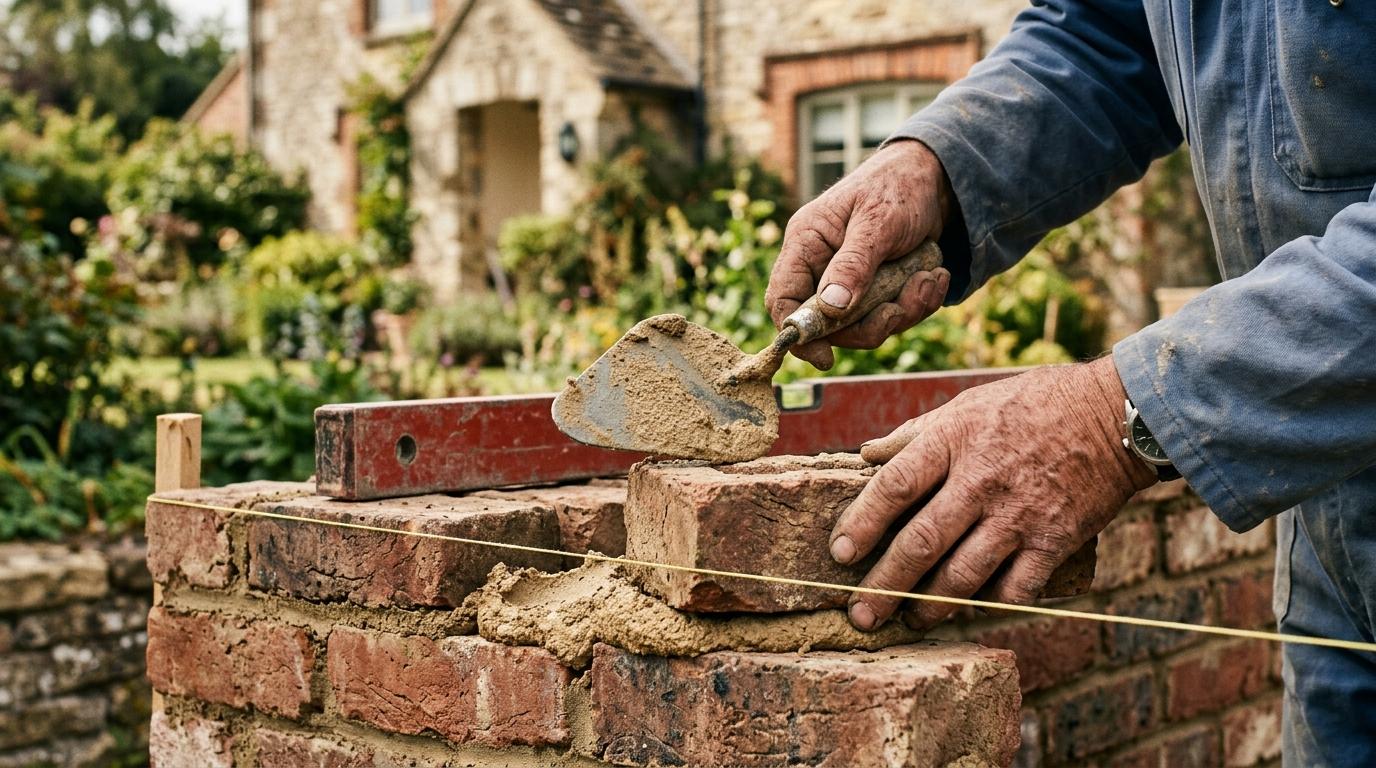
Before you lay a single brick, establish your wall line with a string line pinned at both corners. This is your reference: every course follows it.
Corner profiles
Set up a profile board at each corner (a timber post with horizontal marks at each course height). This lets you run a string line between corners at the exact height of each course without measuring individually.
Gauge
Standard brick gauge in the UK is 75mm per course (65mm brick + 10mm mortar joint). Mark your corner profiles in 75mm increments. Every 4 courses should measure exactly 300mm.
Pier positions
Mark out where corner piers and intermediate piers sit. A pier at each corner, and typically one every 1.5m of run if the wall is over 600mm tall. These are structural points. Get them on your base mark before you start.
Laying courses
Work from corners toward the middle. Lay two or three courses at each corner, then fill the run between them. Always check plumb at corners every second course.
Mortar consistency
Mortar should hold a peak when pressed with a trowel and not slump. If it's too wet it'll squeeze out of the joint; too dry and it won't key properly. Mix in small batches: mortar that's been sitting for 90 minutes is no good.
Frog up or down?
Lay bricks frog-up (the indent facing up) and fill it with mortar. This bonds better and gives more compressive strength than frog-down.
DPC course
When you reach DPC level (150mm above finished slab, or matching the existing house DPC), bed a continuous strip of polythene DPC into the mortar across the full width of the wall. Don't leave gaps. Lap at corners by at least 150mm.
Checks & handover
Level
Each courseTop course must be within ±3mm across any 2m run. Use a long straight edge, not just a 600mm level.
Plumb
Every 2nd courseCheck corners with a plumb bob and a level. Any course over 1mm out cumulates, so check early.
DPC continuity
At DPC levelNo gaps in the DPC run. Lap all joints and corners by 150mm minimum.
Joint finish
While greenStrike joints while mortar is still green (thumbprint-firm). Use a bucket handle jointer or a length of hose pipe for a weather-struck finish.
Cure before loading
Day 7Let the mortar cure for 7 days before sitting the conservatory frame on top.
Community
Reader tips
No tips yet. Be the first to share what worked for you.
Share a tip
Sign in to share what worked for you.
Same category