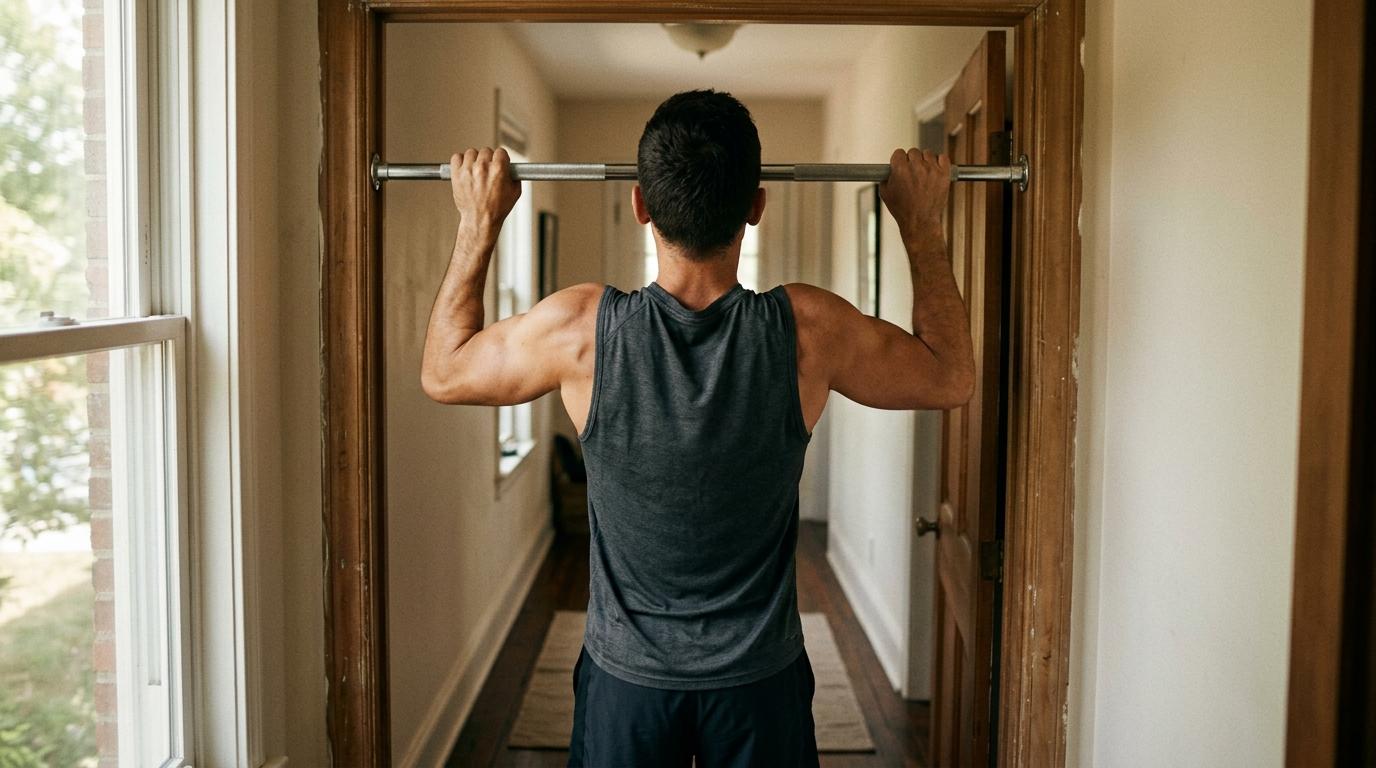
The fundamentals: movement patterns and progressive overload
Strength training is simpler than the fitness industry wants you to believe. The human body has a small number of fundamental movement patterns. Get strong in those patterns and you're strong for life: for carrying, lifting, climbing, and staying healthy across decades. The specifics of which exercises you choose, which gym you join, which programme you follow matter far less than two things: consistency and progressive overload.
The movement patterns
Push: pressing away from the body. Horizontal push: push-ups, bench press. Vertical push: overhead press, pike push-ups. The pushing muscles are the chest, front deltoids, and triceps.
Pull: pulling toward the body. Horizontal pull: rows. Vertical pull: chin-ups, pull-ups. The pulling muscles are the back (latissimus dorsi, rhomboids, rear deltoids) and biceps. Most people have weak pulling strength relative to pushing. Balance here matters for shoulder health.
Hinge: loading the hip joint by pushing the hips back while the spine remains neutral. Deadlifts, Romanian deadlifts, kettlebell swings. The hinge develops the posterior chain: the muscles of the back of the body that are chronically weak in people who sit at desks all day.
Squat: bending at both the hip and knee. Goblet squat, front squat, back squat. Develops the quadriceps, glutes, and core. The squat and hinge together train the entire lower body.
Carry: moving while holding load. Farmer's carry, suitcase carry. Often ignored, carries are among the most functional strength movements: they train grip, core stability, and the coordination of the whole body under sustained load.
Progressive overload
The body adapts to stress. To keep getting stronger, you must progressively increase the demand. Do a little more than last time. An extra repetition. An extra set. A slightly heavier weight. A more difficult variation of an exercise. This principle, progressive overload, is the entire mechanism behind strength development. Every valid training programme is just an organised approach to applying it.
If you're doing exactly the same workout you were doing six months ago, with the same weights and the same reps, you've stopped adapting. You're maintaining, not improving. Neither is wrong (maintenance is a legitimate goal), but know which one you're doing.
Recovery
Strength is built during recovery, not during training. Training is the stimulus; sleep and nutrition are where the adaptation happens. Training three times per week with adequate recovery produces better results than training every day without it. Most beginners improve fastest on two to three sessions per week, with at least one rest day between sessions. Sleep seven to nine hours. Eat enough protein (roughly 1.6–2.2g per kilogram of bodyweight per day for strength training).
Start lighter than you think you need to
Every experienced lifter has watched beginners go too heavy too soon and get hurt or burnt out. Start with a weight (or movement variation) that's easier than you think you can manage. The early weeks are about learning movement quality, not demonstrating what you can lift. Progress comes faster from a solid foundation.
Community
Reader tips
No tips yet. Be the first to share what worked for you.
Share a tip
Sign in to share what worked for you.
Same category
What to learn next

Sleep Better: A Complete Guide to Rest
Build the environment, timing, and mental habits that produce deep, consistent sleep, without medication, gadgets, or hacks.

Tai Chi: A Practical Beginning
Learn the foundations of Yang-style tai chi: rooting, weight transfer, the core principles, and a first short form you can practise anywhere.
Yoga at Home: A Practical Start
Build a sustainable home yoga practice from scratch: postures, breathing, sequencing, and how to create a routine that sticks.
Side quests
Practice drills for this course
One-Arm Push-Up Progression
Build the strength and technique to nail a clean one-arm push-up from scratch.
Wall Handstand Progression
Build a solid wall handstand from zero, developing the strength, balance, and body awareness to hold it confidently.