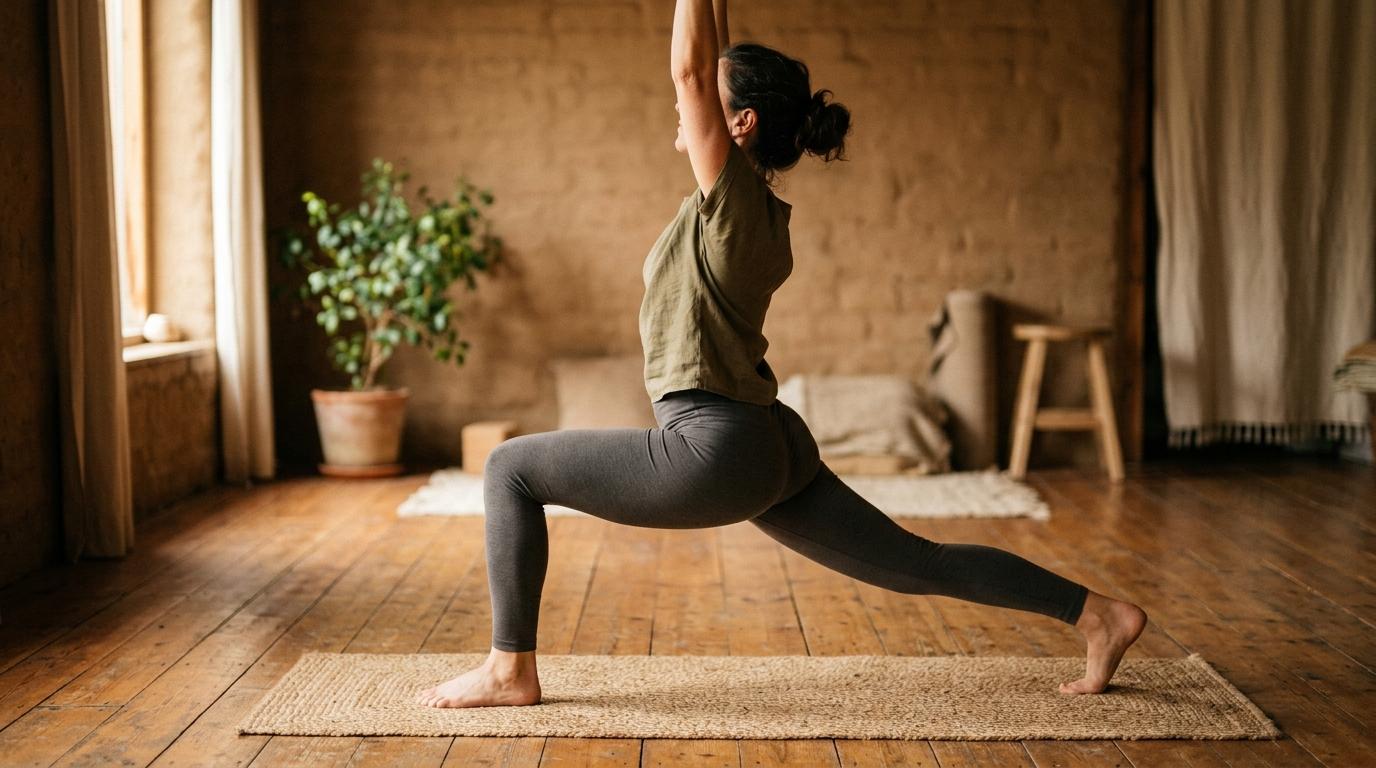
What you need: less than you think
A yoga mat is useful but optional: any non-slip surface works. You need nothing else. No special clothing. No blocks (though a rolled blanket substitutes). No instructor until you want one. The barrier is lower than the industry wants you to believe.
A yoga mat
£10–30A non-slip surface makes balance poses possible and floor work more comfortable. Any mat between 4–6mm thickness works. Budget mats (Yoga-Mad, Amazon Basics) are fine for home practice. You don't need a £80 Lululemon mat to get the same benefit. A mat also creates a physical boundary that signals 'this is practice time'. The psychological effect is worth more than the cushioning.
Affiliate link. We may earn a small commission.
A timer
£0For a 20-minute practice, set a timer and stop when it sounds. Yoga expands to fill whatever time you give it; a timer creates a container. Without one, it's easy to either rush through or spend 40 minutes on three poses. Your phone's built-in timer is fine.
A wall
£0Walls are the most underused yoga prop. Use a wall to support balance poses, check alignment in Warrior I (heel against the wall ensures the back foot is correctly angled), and safely practice inversions. A clear 2m × 2m wall space is enough.
Yoga is not about flexibility
Flexibility is a byproduct of yoga, not its purpose, and not a prerequisite. Many beginners don't attempt yoga because they 'aren't flexible enough.' This is like not going swimming because you're not wet yet. Inflexible people gain more from yoga than already-flexible people. Stiffness is not a disqualification.
Community
Reader tips
No tips yet. Be the first to share what worked for you.
Share a tip
Sign in to share what worked for you.
Same category
What to learn next
Sleep Better: A Complete Guide to Rest
Build the environment, timing, and mental habits that produce deep, consistent sleep, without medication, gadgets, or hacks.
Strength Training
Build real, lasting strength using the fundamental movement patterns: push, pull, hinge, squat. Bodyweight progressions to barbell basics, with a sustainable programme.
Tai Chi: A Practical Beginning
Learn the foundations of Yang-style tai chi: rooting, weight transfer, the core principles, and a first short form you can practise anywhere.