Equipment
pickling needs very little. a jar, a lid, and something sharp enough to slice evenly. the ratios do most of the work. what matters is getting the basics right: sterilised jars, accurate scales, and a consistent slice thickness so everything pickles at the same rate.
Sterilisable glass jars with lids
£2–6 per jar, or reuse any jar with a good lidKilner and Ball jars with their own lids are the standard choice. for fridge pickles, any recycled jam jar with an intact lid works perfectly. for shelf-stable pickles (the kind you want to store in a cupboard for months) use new lids only. old lids may not seal properly under the vacuum of a hot-pack process. wide-mouth jars are easier to fill and clean.
Affiliate link. We may earn a small commission.
Wide-mouth jar funnel
£3–6a stainless steel or BPA-free plastic funnel that sits inside the jar neck makes filling clean and quick. without one, you lose brine down the outside of the jar on every pour. costs almost nothing. saves a lot of wiping.
Affiliate link. We may earn a small commission.
Long-handled tongs or jar lifter
£4–8when sterilising jars in boiling water or lifting hot jars from the oven, you need something to grip them securely. standard kitchen tongs work. a dedicated jar lifter, with rubberised grips shaped to hold jars, is more secure and costs under a fiver.
Affiliate link. We may earn a small commission.
Kitchen scales
£8–20pickling is ratio-based. the salt percentage in a lacto-ferment brine determines whether it works. the vinegar-to-water ratio in a quick pickle brine determines the acidity and shelf life. guessing does not work as well as weighing. any digital kitchen scales accurate to 1g are sufficient.
Affiliate link. We may earn a small commission.
Mandoline or sharp knife
£15–40 for a mandoline; free if you already have a sharp knifeuniform slices pickle at the same rate. thick-and-thin slices in the same jar give you some that are done and some that are undercooked in a day or two. a mandoline set to 3–4mm makes quick work of cucumbers, onions, radishes, and beetroot. a sharp knife and a steady hand achieves the same result more slowly.
Affiliate link. We may earn a small commission.
Where to buy jars (UK)
- Kilner direct (kilnerjar.com): the original UK preserving jar brand; wide range of sizes and clip-top or twist-top lids; often cheaper direct than through retailers.
- Amazon UK: Kilner, Ball, and generic wide-mouth jars; useful for buying in bulk packs of 6 or 12 at a lower unit cost.
- John Lewis kitchenware: carries Kilner and Le Parfait; good for individual jars if you want to try one size before committing to a case.
- Any supermarket: basic pickle jars from the condiment aisle work for fridge pickles. wash well, check the lid seals, and reuse.
for a first batch, two 500ml jars are enough. once you know you enjoy it, buy a case of 12: the unit cost drops sharply.
Some links are affiliate links. Airgap.life may earn a small commission at no extra cost to you.
How to sterilise jars
two methods. oven: wash jars and lids in hot soapy water, rinse, place jars upright on a baking tray in an oven at 120°C for 10 minutes. put lids in a bowl and pour just-boiled water over them, as they're too small for the oven without warping. dishwasher: run a hot cycle immediately before you need them; use jars straight from the hot machine. both methods work. the rule that matters in both cases: fill hot jars with hot liquid. never pour boiling liquid into cold glass. thermal shock can crack the jar.
The science of pickling
there are two distinct methods, and they work by completely different mechanisms. knowing which one you're using, and why, means you understand what can go wrong and how to fix it.
Two Kinds of Pickling
Vinegar pickling works by saturating the food in acid. when you pour a vinegar brine over vegetables, the pH drops below 4.6, the threshold below which most harmful bacteria, including the organism responsible for botulinum toxin, cannot survive. it's fast, reliable, and the results are shelf-stable if properly processed.
Lacto-fermentation works without any vinegar. you submerge vegetables in a salt brine, creating an anaerobic environment that suppresses harmful bacteria while naturally occurring lactobacillus bacteria convert the vegetable sugars into lactic acid. the vegetables acidify themselves. the process takes days rather than minutes, but the flavour is more complex and the pickles contain live cultures.
How Acid Preserves Food
most foodborne pathogens cannot survive in an acidic environment. below pH 4.6, the conditions are hostile to Clostridium botulinum, Salmonella, and most other organisms that cause food poisoning. vinegar achieves this instantly. lacto-fermentation achieves it gradually as the bacteria produce lactic acid. both methods result in a preserved food. the difference is speed, flavour, and whether the product is alive or inert.
The Salt Question
in lacto-fermentation, salt percentage is critical. 2% salt by weight of water creates the right environment: hostile to harmful bacteria, but weak enough for lactobacillus to thrive. too little salt (below 1.5%) and unwanted organisms compete. too much (above 3%) and fermentation stalls. weigh the water and calculate. don't guess.
in vinegar pickling, salt is used partly for flavour and partly to draw water from the vegetables before pickling, a step called pre-salting. it's not the preservation agent; the vinegar is.
Sugar's Role
sugar is not required for preservation. it's there for flavour balance. straight vinegar brine is sharp and one-dimensional. a small amount of sugar rounds it out. the ratio used here, 100g sugar to 500ml brine, produces a pleasantly sweet-sour result. reduce it for sharper pickles, increase it slightly for bread-and-butter style. it does not affect safety either way in a properly acidic brine.
fridge pickles, quick pickles made with vinegar brine and stored in the refrigerator, are the easiest entry point. they last 2–3 months refrigerated and are ready to eat within hours. shelf-stable pickles require the jars to be heat-processed in a boiling water bath after filling, which creates the vacuum seal and eliminates any remaining organisms. both are safe. the processing step is not optional for shelf-stable products.
Your first pickles
quick pickled cucumbers. fridge pickles, ready in 2 hours. this is the method to learn first: it's fast, forgiving, and the result is good. once you've done it once, every other vegetable follows the same logic.
makes 2 × 500ml jars. you need: 2–3 cucumbers, 1 tbsp salt, 250ml distilled white vinegar, 250ml water, 100g caster sugar, 1 tsp dill seeds, ½ tsp mustard seeds, ½ tsp black peppercorns, fresh dill sprigs if you have them.
Sterilise the jars. place 2 × 500ml jars upright on a baking tray. put in the oven at 120°C for 10 minutes. put the lids in a heatproof bowl and pour just-boiled water over them. leave both until you need them.
Salt the cucumbers. slice 2–3 cucumbers into 3–4mm rounds or cut lengthways into spears. place in a colander, toss with 1 tbsp salt, and leave for 30 minutes. the salt draws excess water out of the cucumber, which would otherwise dilute the brine and soften the pickles. after 30 minutes, rinse thoroughly under cold water and pat dry.
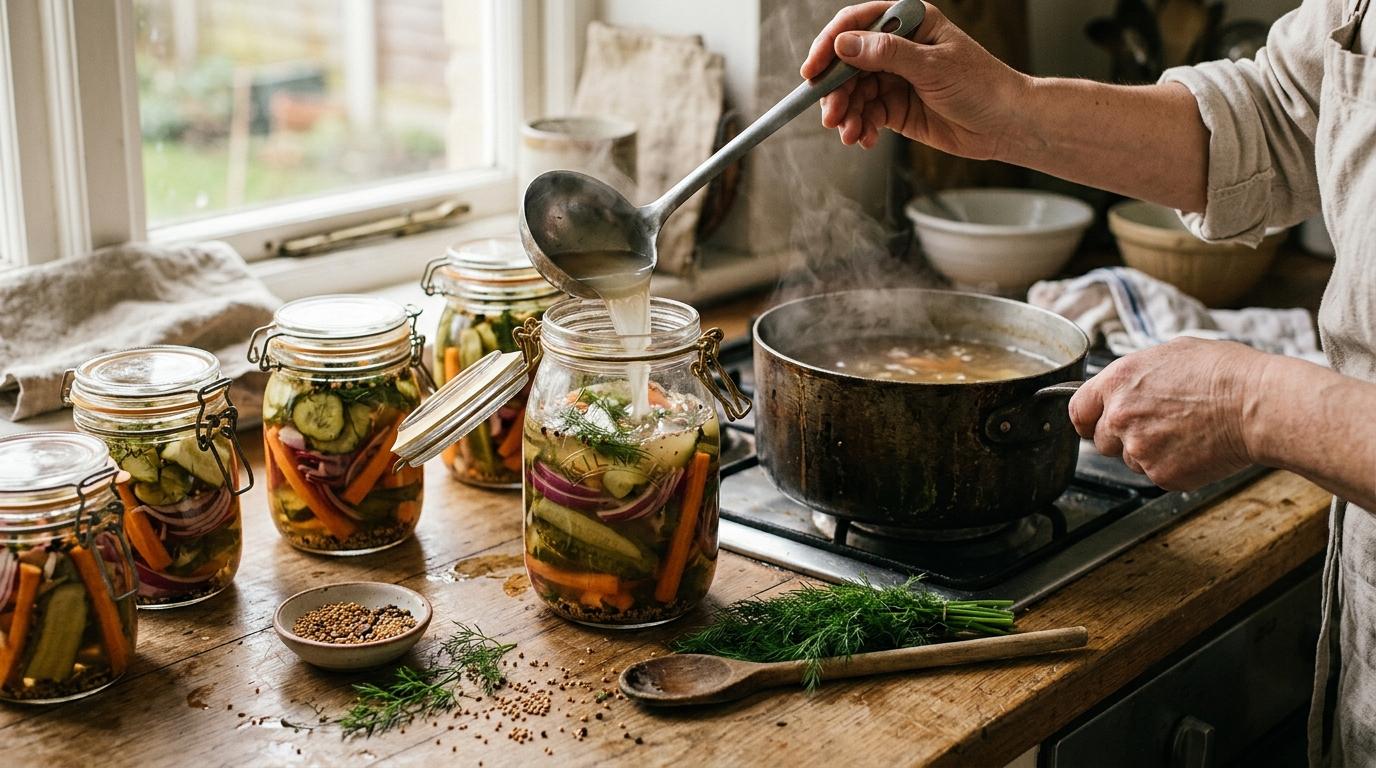
Make the brine. combine 250ml distilled white vinegar, 250ml water, 100g caster sugar, 1 tsp dill seeds, ½ tsp mustard seeds, and ½ tsp peppercorns in a small saucepan. heat over medium heat, stirring, until the sugar has fully dissolved. remove from heat and allow to cool slightly, 2–3 minutes. it should be warm but not boiling when it hits the cucumbers.
Pack the jars. pack the cucumber slices or spears tightly into the warm sterilised jars, layering with a few sprigs of fresh dill if you have them. pack firmly, as the cucumbers will compress slightly. leave 1cm of headspace at the top.
Pour the brine. using a jar funnel if you have one, pour the warm brine over the cucumbers to cover them completely, maintaining the 1cm headspace. tap each jar gently on the counter to release any air bubbles caught between the cucumber slices. lid tightly.
Refrigerate. leave to cool at room temperature for 20–30 minutes, then refrigerate. they are ready to eat in 2 hours. the flavour is best at 24–48 hours, once the spices have had time to infuse. keeps 8–10 weeks in the fridge.
Keep cucumbers crisp
add half a grape leaf or a small piece of fresh horseradish (peeled) to each jar before filling. both contain tannins that inhibit the enzyme responsible for softening cucumbers during pickling. it's a small addition that makes a real difference to the final texture. oak leaves work too. bay leaves have a mild effect.
Fridge pickles are not shelf-stable
these pickles must be kept refrigerated. they have not been heat-processed and the jars have not formed a true vacuum seal. if you want shelf-stable pickles, jars you can store in a cupboard for 12 months, the filled jars must be processed in a boiling water bath for the correct time (typically 10–15 minutes for a 500ml jar of cucumbers). do not assume that hot brine alone is sufficient to create a shelf-stable product. it is not.
What to pickle next
the cucumber recipe is the template. the same logic (pre-salt, make brine, pack, pour, refrigerate) applies to almost every vegetable. what changes is the vinegar type, the spice profile, and sometimes the preparation.
Pickled Red Onions
the quickest pickle there is. slice 2 large red onions into thin rounds. make a brine with 200ml red wine vinegar, 100ml water, 1 tbsp sugar, and 1 tsp salt, and heat until dissolved. pack the onions into a jar, pour the warm brine over, lid, and refrigerate. ready in 30 minutes. transformative on sandwiches, tacos, and anything with rich meat. keeps 4–6 weeks.
Pickled Jalapeños or Chillies
slice fresh jalapeños or green chillies into rings. use the same vinegar-to-water ratio as the cucumber recipe, 1:1 distilled white vinegar to water, with sugar and salt to taste. add 2–3 crushed garlic cloves to the jar. pour warm brine over, refrigerate. better than shop-bought within a week and considerably cheaper.
Lacto-Fermented Pickles
same cucumbers, no vinegar. pack whole small cucumbers or spears into a jar with dill, a few garlic cloves, and mustard seeds. make a brine of 20g non-iodised salt dissolved in 1 litre of water (2% salt by weight). pour over to submerge the cucumbers completely. weigh them down with a small jar or a clip inside. cover loosely with a cloth and leave at room temperature for 3–5 days, tasting daily. when pleasantly sour, lid and refrigerate. these are the real dill pickles: the flavour is different from vinegar pickles, livelier and more complex.
Pickled Beetroot
the classic British condiment. cook small beetroot whole (boiled or roasted) until tender, then peel and slice. make a spiced malt vinegar brine: 300ml malt vinegar, 150ml water, 2 tbsp sugar, 1 tsp allspice berries, 1 cinnamon stick, 3 cloves. bring to a simmer, cool slightly, then pour over the packed beetroot. malt vinegar is the right choice here. distilled white would work but the flavour is wrong. keeps 3 months refrigerated, or process for shelf stability.
Piccalilli
mixed vegetables in mustard-spiced vinegar. cauliflower, green beans, courgette, shallots, all cut small, pre-salted overnight, then coated in a turmeric and mustard sauce made with white wine vinegar. more work than a simple brine pickle but a shelf-stable condiment once properly processed. the British equivalent of German senf-gurken. worth making once you're comfortable with the basics.
Your Pathway to Mastery
First fridge pickle made
Day 1Quick pickled cucumbers or red onions. Understanding the vinegar brine ratio, pre-salting, sterilisation, headspace. Pickles in the fridge that you made yourself.
Shelf-stable processing understood
Month 1–2Boiling water bath processing for shelf-stable jars. Understanding why heat processing is required and how long to process different jar sizes. Your first cupboard-stable batch.
Lacto-fermented pickles attempted
Month 2–32% salt brine, no vinegar. Cucumbers, carrots, or green beans fermented at room temperature. Understanding the difference in flavour and process between vinegar and lacto-fermented pickles.
Piccalilli and mustard pickles
Month 3–6Multi-vegetable pickles with cooked mustard sauce. Understanding how to pre-salt large quantities, build a spiced vinegar base, and jar properly for long-term storage. The foundation of a proper pickle pantry.
Chutney and relishes
Year 1Cooked, chunky preserves with vinegar, sugar, and spice: apple chutney, green tomato chutney, mango chutney. A longer process with more variables, but the same underlying principles. The point at which nothing from the garden or market goes to waste.
The People to Learn From
- River Cottage (Hugh Fearnley-Whittingstall): Preserves book and website; practical, seasonal, and thoroughly British. The River Cottage Preserves Handbook by Pam Corbin covers pickling, jam, chutneys, and curing in exhaustive and reliable detail.
- National Center for Home Food Preservation (NCHFP): nchfp.uga.edu, a US institution, but the science of safe preservation is universal. Their tested recipes for shelf-stable pickles are the standard reference for safe processing times and ratios. Use when you want to go beyond fridge pickles.
- Pam Corbin: Jam and preserves author, River Cottage Preserves Handbook. The most methodical and trustworthy British voice on all forms of preservation. Her ratios and methods are the ones that work.
Best Resources
- None essential. just use kitchen scales. Accuracy matters more than apps.
Community
Reader tips
No tips yet. Be the first to share what worked for you.
Share a tip
Sign in to share what worked for you.
Same category
What to learn next
Home Beer Brewing
Brew your first batch of real ale at home. Equipment, ingredients, the brewing process, fermentation, and bottling, step by step.

Beer: Styles, Serving and Off-Flavours
Beer styles, storage and draught service, glassware, pouring, and the common off-flavours and their causes. Preparation for the Cicerone Certified Beer Server (Level 1) exam.
Bread Baking from Scratch
Your first proper loaf in an afternoon. Flour, water, salt, time, and the foundations of a skill that will feed people for life.