Containers and compost
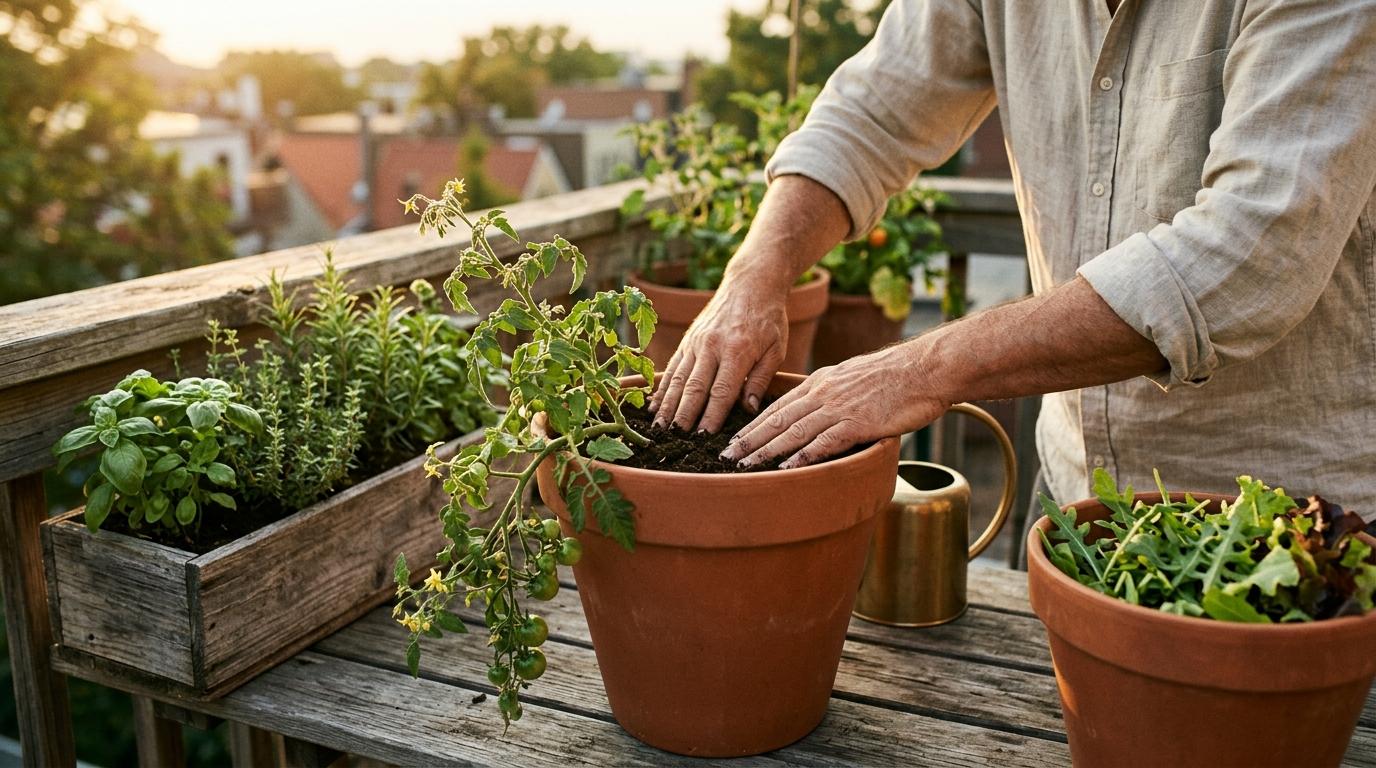
You don't need a garden. A balcony, roof terrace, or even a sunny patio will do. Light is what matters: at least four hours of direct sun for most crops, six or more for tomatoes and courgettes. If you have that, you can grow real food: salad from April to October, herbs year-round on a windowsill, strawberries in hanging baskets, and tomatoes heavy enough to eat every day through August.
The first decision is containers. Get this right and everything else becomes easier. Get it wrong and you spend the season fighting drought, waterlogging, or plants that never thrive because their roots ran out of room.
Choosing your containers
Size is the most important factor. Roots need room, and small pots dry out in hours on a hot day. For tomatoes and courgettes, you need at least 30–40 litres. For salad, herbs, and strawberries, 10–20 litres is enough. For deep-rooted crops like carrots, a tall container matters more than a wide one.
Container volume is the single biggest factor in whether a plant thrives or struggles. When in doubt, go bigger.
Large plastic planters (40L+)
£8–20 eachLightweight, frost-proof, and cheap. Darker colours absorb heat, which suits tomatoes and peppers. Look for ones with drainage holes already punched. If not, drill your own.
Affiliate link. We may earn a small commission.
Terracotta pots
£5–25 eachHeavy, beautiful, and porous, which means they breathe well and roots stay healthy, but they also dry out faster. Best for herbs like rosemary, thyme, and lavender that prefer drier conditions. Wrap in bubble wrap over winter if you want to avoid frost cracking.
Affiliate link. We may earn a small commission.
Fabric grow bags (25–50L)
£10–20 for a pack of 5Air-prune roots naturally, which prevents pot-bound plants and encourages bushier growth. Fold flat for storage. Excellent for potatoes and tomatoes. Handles make them easy to move around the balcony as the season changes.
Affiliate link. We may earn a small commission.
Self-watering planters
£20–50 eachA reservoir in the base wicks water up to roots as needed. Ideal if you travel or forget to water. Works brilliantly for tomatoes, peppers, and herbs. The upfront cost pays off in fewer lost plants.
Affiliate link. We may earn a small commission.
Window boxes and railing planters
£10–25 eachUse every vertical inch of your balcony. Railing-mount versions hook over the rail without drilling. Good for trailing tomatoes, herbs, nasturtiums, and cut-and-come-again salad.
Affiliate link. We may earn a small commission.
Compost matters more than anything
Garden soil isn't suitable for containers. It compacts, drains badly, and introduces pests. You need a purpose-made peat-free compost. Multi-purpose compost works for most crops. Mix in perlite (about 20% by volume) to improve drainage and stop the compost compacting over the season.
Peat-free multi-purpose compost (50–70L bags)
£8–15 per 50L bagThe foundation of every container. Buy peat-free: it performs as well as peat-based and is far better for the environment. Refresh the top third of containers each spring; replace fully every two years.
Affiliate link. We may earn a small commission.
Perlite
£8–12 per 10L bagVolcanic glass granules that improve drainage and aeration. Mix roughly 1 part perlite to 4 parts compost. Dramatically reduces waterlogging and root rot, especially in large containers that hold moisture deep down.
Affiliate link. We may earn a small commission.
Watering on a balcony
Containers dry out faster than you expect. On a hot July day, a large pot can need a full watering can. Check soil moisture daily by pushing a finger two centimetres into the compost. Water until it runs from the drainage holes, then stop. Shallow watering encourages shallow roots and makes the problem worse.
The single biggest mistake
Under-watering is the most common cause of container growing failure. If your tomato leaves curl in the morning, the plant is already water-stressed. In hot weather, larger containers may need watering twice daily. A self-watering planter or a drip system removes this pressure completely.
Long-reach watering can (9–10L)
£12–25A long spout lets you water precisely at the base of plants without wetting foliage. The extra capacity means fewer trips to the tap. Essential for a balcony without a nearby hose connection.
Affiliate link. We may earn a small commission.
Drip irrigation kit
£25–60Connects to a tap and delivers water on a timer. A complete system for 20–30 pots can be set up in an afternoon. If you travel, or simply want to stop worrying, this is the upgrade that makes balcony growing sustainable.
Affiliate link. We may earn a small commission.
Liquid tomato feed (Tomorite or equivalent)
£5–10 per bottle (lasts a full season)Containers are a closed system: nutrients leach out with every watering. From June onwards, feed tomatoes, peppers, courgettes, and hungry herbs weekly with a high-potash liquid feed. This is the difference between disappointing plants and a productive harvest.
Affiliate link. We may earn a small commission.
Where to buy containers and compost
- Crocus: Good range of peat-free compost and premium containers. Good for rarer varieties.
- Wilko / B&M: Cheapest source of plastic pots and basic compost. Fine for getting started.
- Thompson & Morgan: Mail-order seeds and young plants. Useful if local garden centres have limited variety.
- Dobbies / local garden centres: Best for seeing containers in person and buying young plants in season (April–June).
- Amazon: Reliable for bulk perlite, self-watering planters, and irrigation kits where local stock runs out.
Buy compost locally if you can: delivery costs make large bags uneconomical online. Containers are worth buying in person so you can judge quality and size.
Some links are affiliate links. Airgap.life may earn a small commission at no extra cost to you.
Community
Reader tips
No tips yet. Be the first to share what worked for you.
Share a tip
Sign in to share what worked for you.
Same category
What to learn next
Your First Allotment
How to get an allotment, plan your plot, improve the soil, and grow your first full season of vegetables. The complete beginner's guide to UK allotment growing.
Colony Management and Bee Health
Inspecting and managing a honeybee colony: the seven-point frame check, swarm control, varroa and the notifiable foul broods, honey handling and the law. Preparation for the BBKA Basic Assessment.
Composting
Learn to make great compost: bin types, the browns and greens balance, hot and cold methods, troubleshooting, and using the finished product across the garden.
Side quests