
The Missing Lesson
Self-regulation is the ability to manage what you feel. To move through anxiety, anger, grief, or overwhelm without being completely swept away. To pause before reacting. To feel safe in your own body even when things are hard.
Most people assume this is just personality. That some people are naturally calm and some aren't. That's not what the evidence shows. Self-regulation is a learned skill. The problem is that it's learned in the first years of life, mostly without anyone realising it's being taught.
How it's normally learned
Babies are born with no capacity to regulate their emotional states at all. When a newborn is distressed, they have exactly one response: scream. They can't soothe themselves. They can't wait. They can't reason their way out of the feeling. The only thing that works is another person.
When a caregiver responds, picks the baby up, speaks in a low calm voice, holds them close, something is happening at a neurological level. The caregiver's regulated nervous system is lending itself to the infant. The baby's stress hormones drop. Heart rate slows. Breathing settles. Over thousands of these interactions, the baby learns that distress is temporary, that calm follows, and that other people are safe.
This is called co-regulation: a regulated adult helping a dysregulated child return to calm. Over time, the child internalises this. They begin to do it for themselves.
The critical window is roughly the first five to seven years of life, though development continues through adolescence. During this period the brain is highly plastic, building its emotional regulation circuits in direct response to experience.
What happens when the lesson gets missed
A caregiver doesn't need to be abusive or neglectful for this learning to be disrupted. They may be struggling with their own unregulated nervous system, depression, anxiety, addiction, their own childhood trauma, and unable to offer consistent calm. Overwhelmed by circumstance: illness, poverty, isolation, grief. They may have been taught that emotions are dangerous or shameful, and pass that teaching on without meaning to.
None of this is about blame. Most caregivers who couldn't co-regulate their children were never properly co-regulated themselves. The deficit passes between generations not through cruelty but through absence.
What the child learns in these conditions is different. Distress doesn't reliably resolve. Calm doesn't reliably come. Other people don't reliably help. The nervous system, adapting to this reality, learns to stay alert. To scan for danger. To not fully relax, because relaxing hasn't been safe.
You may never have been taught to calm down. You may have been told to "stop crying," "toughen up," "get over it," or "stop being so sensitive." These responses, however well-intentioned, teach a child that their emotional state is a problem to be hidden rather than a signal to be understood. The result is not a child who stops feeling. It's a child who stops showing it. Eventually, a person who no longer knows what they feel at all.
Does this sound like you?
You're probably reading this because something resonates. Maybe you can't come down after a stressful event. Maybe you feel chronically on edge without knowing why. Maybe you react to small things as if they were large ones and feel embarrassed about it afterwards. Maybe you feel numb more than anything else.
These aren't character flaws. They're the predictable results of a nervous system that was never taught the full process of emotional regulation. And they can be unlearned. The rest of this course explains how.

Your Nervous System Under Pressure
Before you can change how your nervous system behaves, it helps to understand what it's doing. The reactions you experience aren't random, irrational, or a sign of weakness. They're a biological system doing exactly what it was built to do. Understanding this tends to shift the relationship with your own responses from shame to curiosity.
The amygdala: your smoke alarm
Deep inside your brain sits a small, almond-shaped structure called the amygdala. It's not responsible for rational thought. It doesn't process language or weigh evidence. What it does is detect threat, and it does so faster than any other part of your brain, often before conscious awareness registers anything at all.
The amygdala works by pattern matching. It holds a library of situations, sensations, and experiences associated with danger. When it detects a match, a tone of voice, a particular smell, a sudden movement, a certain kind of silence, it fires. Something is wrong. Prepare.
The amygdala doesn't distinguish reliably between past and present. A tone of voice that felt threatening in childhood will trigger the same alarm response as a real threat today. The library was built when you were very young, and its entries resist rational override. This is why you can know, intellectually, that you're not in danger, while your body behaves as if you are.
Fight, flight, freeze, and fawn
When the amygdala fires, the body moves into one of four stress responses. Most people know fight and flight. Fewer recognise freeze and fawn, but for many people who grew up in unpredictable environments, these are the dominant patterns.
Fight is the urge to confront, argue, push back, or attack. In a genuinely dangerous situation, this is adaptive. In an office meeting or a difficult conversation, it feels disproportionate and leaves you embarrassed afterwards.
Flight is the urge to leave, avoid, or escape. This shows up as literally leaving a situation, but also as distraction, overworking, scrolling, drinking: anything that creates psychological distance from the feeling.
Freeze is the nervous system's shutdown response. Not paralysis exactly, but a dissociation from the situation: going blank, losing words, feeling unable to move. Common in situations where neither fight nor flight was an option, particularly in childhood.
Fawn is a response identified more recently, particularly in early relational trauma. It's the impulse to appease: to become immediately agreeable, helpful, and self-effacing in the face of perceived threat. Children who grew up with unpredictable or frightening caregivers often learned that compliance was the safest response. As adults, this looks like people-pleasing, difficulty saying no, or chronic self-erasure.
Most people have a dominant response but can shift between all four depending on context. Recognising which one is firing, and when, is one of the most useful things you can learn about yourself.
Hyper-vigilance: life on high alert
When the threat-detection system is calibrated to a high-danger environment and then that environment changes, as it does when a child grows up, the alarm doesn't automatically recalibrate. The nervous system continues scanning at the same frequency. This is hyper-vigilance: a chronic low-level (sometimes not so low-level) state of alert that doesn't match the actual threat in the current environment.
Hyper-vigilance is not a personality trait. It is a nervous system doing its best with the instructions it was given.
Common signs: difficulty relaxing in objectively safe situations; a strong startle response; scanning rooms for exits or the emotional state of others; difficulty sleeping because the nervous system can't fully downshift; emotional reactions that feel too large for what triggered them; a persistent low-grade sense of dread that attaches to nothing specific.
People experiencing hyper-vigilance often describe waiting for something bad to happen even when nothing is wrong. Some have lived with this so long they assume it's what being alive feels like.
Your body is not betraying you
This is the most important reframe in this course: the reactions you've been carrying, the anxiety, the emotional floods, the numbness, the vigilance, are not signs that something is wrong with you. They're signs your nervous system is functioning exactly as it was trained to. It adapted to the environment it was in. The adaptation served you then. It's costing you now.
The work of self-regulation isn't about suppressing these responses. It's about updating the system. Teaching the nervous system, through repeated experience, that it's safe to come down from alert. That calm is survivable. That not everything that looks like the past is the past.

The Vagus Nerve Toolkit
The vagus nerve is the longest cranial nerve in the body, running from the brainstem through the neck, chest, and abdomen to the heart, lungs, and gut. It's the main highway of the parasympathetic nervous system: the branch responsible for rest, digestion, and recovery.
When the vagus nerve is active, heart rate slows, breathing deepens, digestion resumes, and the body shifts from defensive readiness into relative safety. This is "rest and digest," as opposed to the sympathetic system's "fight or flight."
You can influence this nerve deliberately. You can't directly command your heart to slow down or your cortisol to drop, but you can create the conditions that signal to the nervous system that the threat has passed. That's what the techniques below do.
Polyvagal theory: three states
Psychiatrist Stephen Porges developed polyvagal theory: a model of the nervous system that identifies three distinct states, each controlled by a different branch of the vagal system.
The ventral vagal state is safety and connection. This is where you can think clearly, engage socially, feel curious and open, tolerate disagreement without feeling threatened. The prefrontal cortex is online. Relationships feel manageable. This is the state the techniques below are trying to reach.
The sympathetic state is activation and mobilisation: fight or flight. Energy is mobilised, heart rate and breathing increase, attention narrows to the perceived threat. Necessary and useful when the threat is real. A problem when it's the default.
The dorsal vagal state is shutdown and immobilisation: the freeze response at its extreme. Collapse, dissociation, profound flatness. The oldest and deepest survival response, associated with situations in which neither fight nor flight offered any prospect of safety. Numbing, checked out, not quite present.
The work of regulation isn't to move from sympathetic to calm. It's to move toward ventral vagal, genuine safety and connection, rather than collapsing into dorsal vagal shutdown, which can look like calm but is a different kind of crisis.
Techniques that activate the vagus nerve
These aren't tricks. They're physiological levers, interventions that directly signal the autonomic nervous system through the pathways the vagus nerve controls.
Extended exhale breathing. Inhalation activates the sympathetic system; exhalation activates the parasympathetic. Breathing with a longer exhale than inhale shifts the balance toward calm. In for four counts, out for eight. Even three or four breath cycles creates a measurable shift.
The physiological sigh. Breathe in through the nose, then before exhaling take a second short sniff in on top. This fully inflates the alveoli. Then release in a long, slow exhale through the mouth. Stanford research shows this is the fastest way to reduce physiological stress. One or two is enough.
Cold water on the face. Submerging your face in cold water, or splashing cold water on your forehead and temples, triggers the mammalian diving reflex: a hardwired response that slows heart rate and shifts nervous system state. Practical in a bathroom during a difficult moment. Effective in seconds.
Humming, singing, or gargling. The vagus nerve passes through the throat. Vibrating it, through humming, singing, chanting, or vigorous gargling, directly stimulates the nerve. Not a metaphor. Anatomy. Thirty seconds of humming creates a shift.
Social engagement. According to polyvagal theory, the ventral vagal state is a social state. It's activated by gentle eye contact, a warm voice, the presence of a regulated other person. This is why calling a calm friend during a difficult moment works, and why social isolation tends to push the nervous system toward defensive states.
Bilateral stimulation (tapping). Alternately tapping your left and right knees, or crossing your arms and tapping alternate shoulders, engages bilateral hemispheric processing and tends to reduce the intensity of emotional arousal. A simplified version of a technique used in EMDR therapy. Works well during mild to moderate distress.
Grounding: the 5-4-3-2-1 method. When overwhelmed, the nervous system loses its anchor in the present. Name five things you can see, four you can physically feel, three you can hear, two you can smell, one you can taste. It forces the sensory cortex to engage with the present rather than the imagined threat. Simple and embarrassingly effective.
None of these techniques will resolve a nervous system that's been in chronic activation for years. They will give you a tool for the moment: something to do with your body when the alarm fires. Over time, repeated use begins to train the nervous system to access calmer states more easily. Think of it as building what Porges calls vagal tone: the system's capacity to flex between activation and rest.
Building a personal toolkit
Not every technique works equally well for every person. This is partly neurological, partly circumstantial. Find two or three that reliably create a shift for you: ones you can reach for quickly in a difficult moment without having to think about which one to use.
The goal isn't to eliminate the stress response. It's to shorten its duration and reduce its intensity. To move from swept away to standing in it. To build the window of tolerance: the range of experience within which you can feel difficult things without flooding or shutting down.

Getting Real Help
The techniques in step three are real and they work. But if your nervous system has been in chronic dysregulation for years, calibrated in early childhood to a high-threat environment, self-help is unlikely to be sufficient on its own. This isn't a failure of effort or commitment. It's the nature of the problem.
The nervous system changes through experience, not through understanding. You can understand intellectually that you're not in danger, that your caregiver's behaviour wasn't your fault, that you're now safe. That understanding is valuable. But the amygdala doesn't respond to intellectual arguments. It responds to experience: being in a regulated relationship, over time, with another person, returning from activation to safety repeatedly, in the context of genuine connection.
This is, at its core, what therapy is.
Why not all therapy is the same
Standard talking therapy, weekly conversations about your thoughts and feelings, can be helpful and is far better than nothing. But for nervous system regulation, therapies that work with the body tend to be more directly effective. Self-regulation is a subcortical process, happening below the level of conscious thought. Talking to the thinking brain about it has limits.
Somatic Experiencing (SE) was developed by Peter Levine and focuses on completing the biological stress response that gets stuck in the body. The therapist tracks physical sensations and movements, helping the client discharge the activation that the original trauma prevented from completing. Gentle, body-oriented, and well-suited to early relational trauma. Waking the Tiger by Peter Levine is a good introduction.
EMDR uses bilateral stimulation, typically tracking a moving light or the therapist's hand, while processing a distressing memory. The mechanism isn't fully understood, but the evidence for its effectiveness is strong. It helps the brain process and integrate experiences that have remained stuck, reducing their intensity.
Internal Family Systems (IFS) works with the idea that the psyche contains distinct parts: the inner critic, the people-pleaser, the shut-down child, the angry protector. Rather than suppressing or overriding these parts, IFS works to understand their original protective function and bring the system into greater harmony. No Bad Parts by Richard Schwartz is the definitive introduction.
DBT (Dialectical Behaviour Therapy) was developed to build emotion regulation skills, with a structured curriculum of mindfulness, distress tolerance, emotional regulation, and interpersonal effectiveness. Particularly useful for people who experience intense emotional responses and want practical, learnable skills.
Compassion-Focused Therapy (CFT) works with the self-criticism and shame that often accompany early relational trauma. Many people who grew up without adequate co-regulation also grew up with the internalised message that they were too much, too sensitive, or fundamentally flawed. CFT works directly with this.
The Body Keeps the Score by Bessel van der Kolk remains the most widely read account of how trauma lives in the body and what helps. Useful background before or alongside any of the above.
The Polyvagal Theory by Stephen Porges is the academic source for the framework used throughout this course. Denser reading, worth it if you want to understand the neuroscience in depth.
When looking for a therapist, the most important factor isn't their modality but whether they're trauma-informed. A trauma-informed therapist understands that symptoms of dysregulation are adaptations, not character flaws; works at a pace that doesn't retraumatise; and prioritises the client's sense of safety above following a rigid protocol. You can ask directly: "Are you trauma-informed? What modalities do you use for nervous system regulation?" A good therapist will welcome the question.
Where to start in the UK
In the UK, you can access NHS talking therapies through self-referral via the NHS Talking Therapies programme. This typically provides CBT or counselling; waiting times vary by area. For somatic or specialist trauma therapies, private therapy is usually required.
The BACP (British Association for Counselling and Psychotherapy) and UKCP (UK Council for Psychotherapy) both maintain searchable directories of registered therapists. Filter for "trauma-informed" and your preferred modality.
If you're struggling right now, the Samaritans are available 24 hours a day, 365 days a year: call 116 123 (free from any phone in the UK and Ireland). Mind offers mental health information, local services, and an online community. Rethink Mental Illness provides advice and peer support for people affected by severe mental illness.
For specialist trauma therapies, the EMDR Association UK and Somatic Experiencing Association UK both list accredited practitioners. Many offer sliding-scale fees for those in financial difficulty. Always worth asking.
Understand what self-regulation is
FoundationRecognise that self-regulation is a learned skill, not a personality trait, and understand how co-regulation works in early development.
Identify your dominant stress response
AwarenessLearn to notice whether you tend toward fight, flight, freeze, or fawn, and what triggers each pattern for you.
Recognise your signs of hyper-vigilance
AwarenessMap the physical and emotional signals that tell you your nervous system is running on high alert.
Learn two or three vagal techniques
PracticePractise extended exhale breathing, the physiological sigh, humming, or grounding until they feel natural to reach for.
Use a technique in a real moment of stress
PracticeApply one of the techniques during an actual difficult moment, not just in practice, and notice whether it creates a shift.
Research therapy options
Next stepsLook into SE, EMDR, IFS, DBT, or CFT depending on what resonates. Identify two or three trauma-informed therapists to consider.
Take the first step toward professional support
Next stepsMake contact with a therapist, self-refer to NHS Talking Therapies, or book a consultation: whatever the next concrete action is for you.
Community
Reader tips
No tips yet. Be the first to share what worked for you.
Share a tip
Sign in to share what worked for you.
Same category
What to learn next
Dog Training: The First Six Weeks
Reward-based foundation training for a new dog: markers, recall, loose-lead walking and a settle, built in six weeks of short daily sessions.
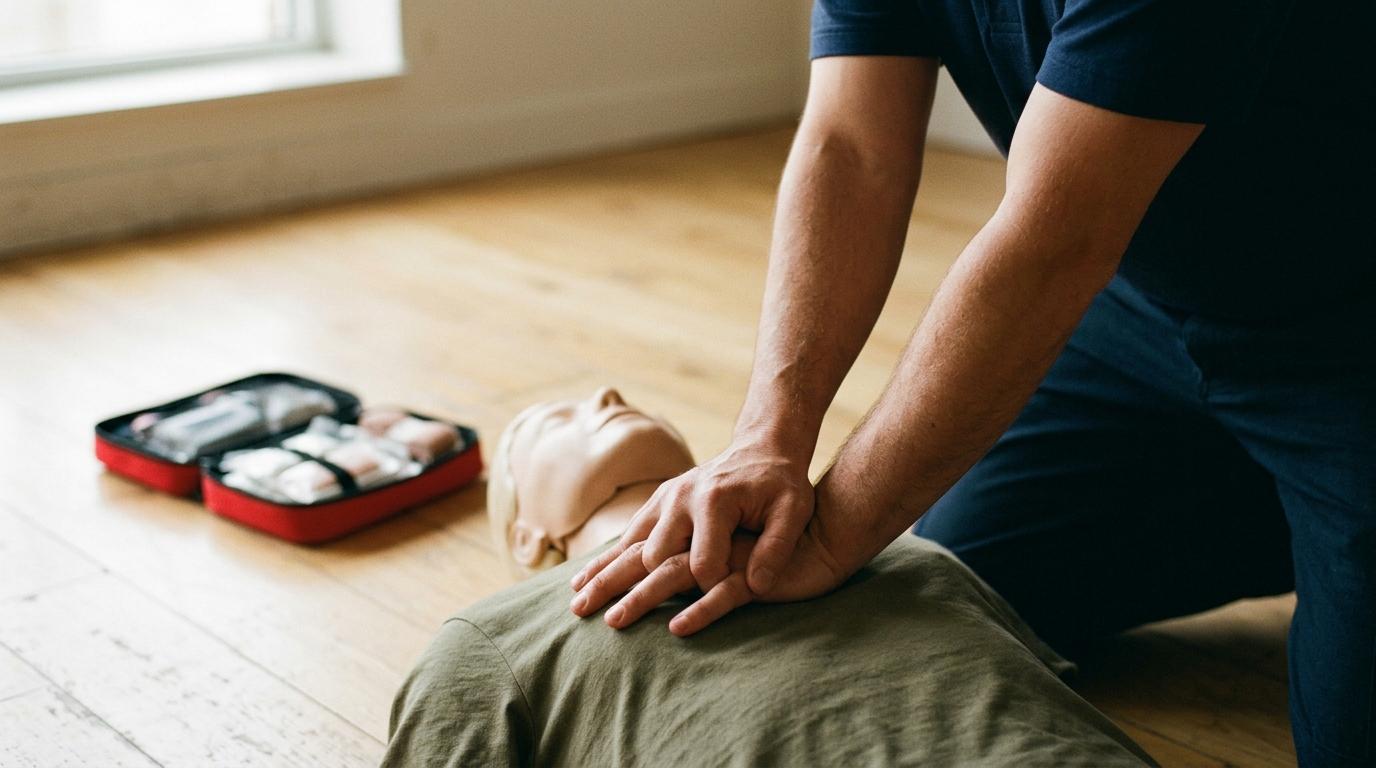
First Aid Essentials
CPR, choking response, wound management, burns, and fractures. The skills that matter most when there's no one else. Practical, remembered under pressure.

Journaling
How to build a journaling practice that lasts: formats, prompts, methods for processing difficult things, and making it a habit that compounds over years.
Side quests